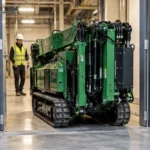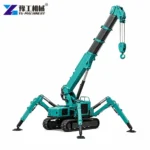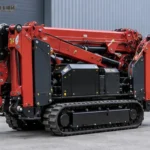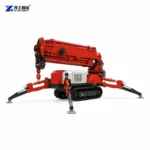
An electric spider crane is a tracked mini crane configured to work from battery power, mains electricity or another manufacturer-approved low-emission supply. Buyers normally consider it for factories, shopping centers, glazing, equipment installation and other restricted sites where exhaust, noise and access matter. The purchasing decision still begins with the lift: gross load, maximum radius, hook height, outrigger position and supporting floor.
Electric drive does not increase the load chart and does not remove the need for ground assessment. It changes the site utility, charging, duty-cycle and emergency-recovery plan. This page helps buyers define those items before YG confirms an available configuration. For the base machine range, see the tracked mini crane; capacity at real geometry is explained in the working-radius guide.
Why Outriggers Determine Spider Crane Stability
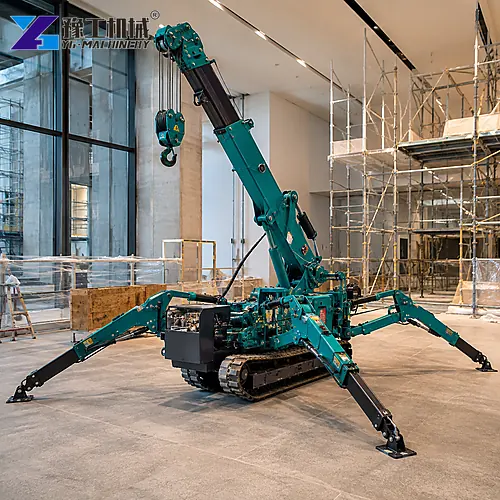
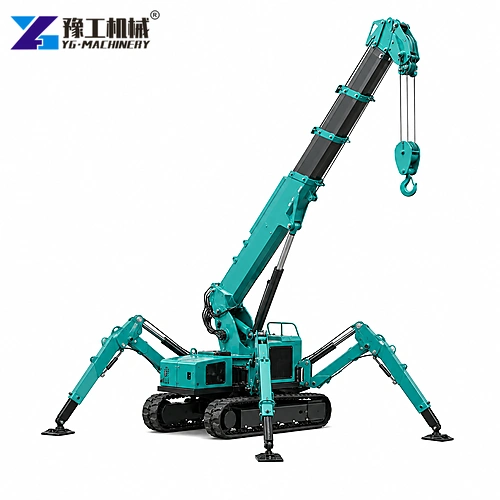
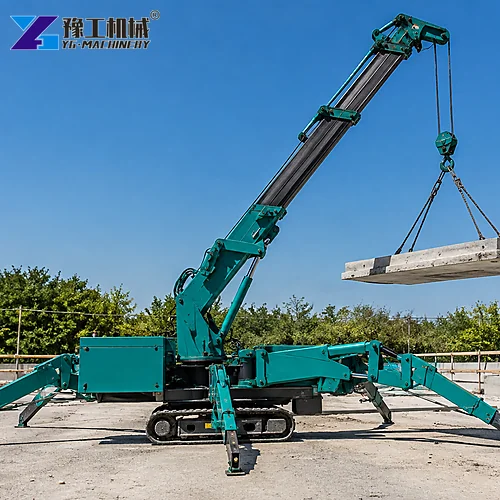
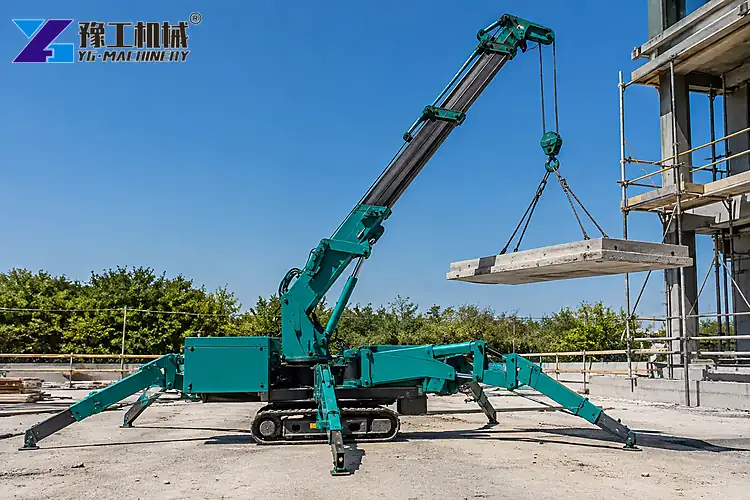
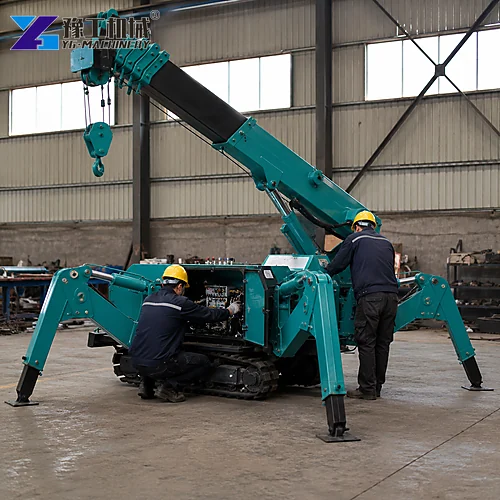
The crawler tracks move the machine into position, but the outriggers create the working support polygon for lifting. Each jack transfers a portion of the crane, attachment and lifted-load forces into the floor or ground. As the boom slews, the most heavily loaded outrigger changes. Dynamic effects from starting, stopping, wind or a swinging load add to the static reaction, so setup must follow the manufacturer’s load chart and operating manual rather than visual judgment.
A wide, symmetrical stance generally provides the largest support area. Real sites often contain walls, pits, production equipment or pedestrian routes that prevent full extension. Many modern cranes offer several approved outrigger positions; each position has a corresponding rated-capacity chart or control-system limit. If the exact configuration is not documented, treat it as unavailable. Improvised half positions can place the load outside the stable polygon before the operator recognizes the problem.
Before comparing models, ask suppliers for charts covering every permitted outrigger pattern, not only the best configuration. Confirm whether the system detects each leg position automatically, how it limits unsafe boom movements and whether the display shows the current allowable load. These controls support the operator, but they do not replace competent planning or ground assessment.
Measure the Lift Before Selecting the Crane
Record the load weight, load dimensions, center of gravity and approved lifting points. Add the mass of the hook block, slings, shackles, spreader beam, vacuum lifter or other below-the-hook equipment. The resulting gross load is the figure to compare with the capacity chart. If the weight is estimated, use a conservative verified value; packaging labels and supplier drawings are more reliable than appearance.
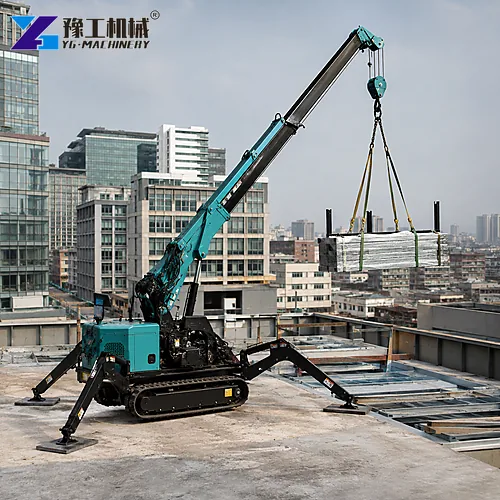
Next measure the horizontal working radius from the crane’s center of rotation to the load’s center of gravity at the most demanding point of the lift. Include the pickup, travel and final placement positions. Also determine hook height, required clearance above the load, building height, boom-tip clearance and any need to reach over an obstruction. A short pickup radius does not help if final placement occurs farther away.
Draw a plan view and elevation. Mark the machine body, outriggers, load path, walls, columns, doors, overhead services and exclusion zone. This small exercise often reveals that access width or boom clearance—not nominal capacity—is the controlling constraint. For compact alternatives, compare the 3 ton spider crane, 5 ton spider crane and tracked mini crane pages against the measured geometry.
Understand Working Radius and Load Charts
Working radius is a horizontal distance, not boom length. Increasing radius increases overturning moment even when the load weight remains unchanged. That is why rated capacity usually drops quickly as the boom lowers or telescopes. Read the row for the actual boom length and the column for the actual radius, then use the lowest applicable rating across the planned path.
Capacity charts may differ by outrigger extension, boom section, jib use and operating sector. Some ratings are limited by structural strength while others are limited by stability. Do not interpolate upward between chart values. If the measured radius lies between two entries, use the more conservative entry unless the manufacturer specifies another method. Keep a reserve for measurement uncertainty and normal operational variation.
The crane’s moment limiter or rated-capacity indicator is an essential safeguard, but the lift should already be valid on paper. Confirm that sensors, alarms and emergency stops function during pre-use checks. An alarm is a stop signal, not permission to repeatedly approach the limit.
Inspect Ground and Floor Capacity
A compact crane can create high point loads at its outrigger feet. Concrete thickness, reinforcement, suspended slabs, underground services, trenches, basements, backfilled areas and floor openings all matter. Obtain allowable bearing information from the site owner or a qualified engineer when the support condition is uncertain. A visually sound slab may not be designed for concentrated crane reactions.
Outrigger mats spread reaction over a larger area. Size them from the maximum expected outrigger load and allowable ground bearing pressure, while also checking mat strength and edge distance. Place mats flat on a prepared surface, center each foot and keep the jack vertical. Timber scraps, loose blocks and stacked irregular packing can split or eject under load.
Recheck level after the crane is raised onto its outriggers. If a leg settles, the lift must stop and the support must be corrected. Never use the hydraulic jacks to compensate for ground that is continuing to move. Record the approved setup so the next shift does not unknowingly alter a critical mat or barrier.
Plan Access and Indoor Operation
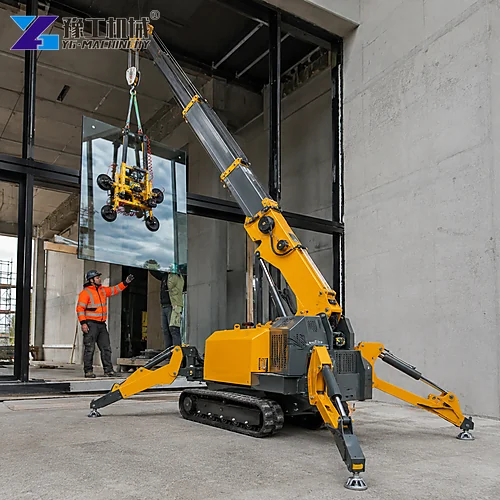
Measure door width and height, corridor turns, ramp angle, floor loading and transport weight before delivery. Retracted dimensions should include any attachment, hook or removable counterweight needed for travel. Protect finished floors where required and verify that ramps can carry the machine. A spotter should guide blind corners and keep pedestrians outside the travel path.
For indoor work, choose an electric or battery mode when available and suitable. Engine exhaust, ventilation, noise, charging, cable routing and fire precautions must be addressed in the method statement. Electric operation reduces local emissions but does not change lifting limits. The same outrigger, radius and exclusion-zone rules still apply.
Compact access is valuable only when the crane can also deploy safely at the work point. A machine that fits through a doorway may still need more floor area for its outriggers and tail swing. Verify both travel envelope and operating envelope on the site drawing.
COMPARE ELECTRIC POWER OPTIONS
Choose Power and Controls for the Site
Remote control gives the operator freedom to stand where the load, landing point and signaler are visible. The operator should select a position outside pinch zones and away from the potential fall path. Test command direction at low speed before lifting, and maintain secure possession of the transmitter so no unauthorized person can activate the crane.
Battery-electric and mains-electric options suit sensitive indoor projects, while diesel power supports remote outdoor work. Compare duty cycle, charging time, cable requirements, ambient temperature and expected daily lifts. Ask whether simultaneous charging and operation is permitted and how emergency recovery works after a power loss.
Smooth proportional controls are especially useful for glazing, machinery installation and façade work. However, precision also depends on appropriate rigging, clear communication and a stable load. Speed settings should match the task, with slow modes used near final placement.
CONFIRM MY CRANE CONFIGURATION
| Electric configuration item | Data required before selection |
| Rated lifting capacity | Model rating plus the load chart at the actual radius |
| Hook height and working radius | Required geometry for every planned lift |
| Machine size and mass | Folded access envelope, transport route and floor loading |
| Outrigger arrangement | Available footprint, reactions and approved support method |
| Power source | Battery, mains or approved hybrid supply |
| Electrical input | Site voltage, phase, frequency and protective devices |
| Battery duty | Usable operating period, charging time and shift plan |
| Controls | Remote functions, emergency recovery and site restrictions |
Buyer Checklist and Total Operating Cost
Compare capacity at your actual radius, maximum hook height, approved outrigger patterns, travel dimensions, machine mass, power options and attachment compatibility. Request load charts, manuals, certificates, spare-parts lists, training details and warranty terms before ordering. A supplier should be able to explain chart assumptions and provide a configuration that matches the lift study.
Purchase price is only one component of cost. Include delivery, lifting accessories, mats, inspections, operator training, batteries, charging equipment, maintenance, wire-rope replacement and expected downtime. Service access and parts availability can be more valuable than a small difference in initial price, especially when the crane supports time-critical installations.
Send YG Machinery the gross load, maximum radius, hook height, access dimensions, floor information, power preference and project location. Those facts allow a useful recommendation instead of a capacity guess.
Frequently Asked Questions
No. Maximum capacity normally applies only to a limited short-radius configuration. Capacity falls as radius and boom length increase. Always use the chart for the actual boom and outrigger setup.
They may be required because an outrigger creates concentrated load. The slab and supporting structure must be verified, and mats should be sized from reaction and allowable bearing pressure rather than chosen by appearance.
Only if the manufacturer explicitly provides a pick-and-carry procedure and rating for that model and configuration. Standard stationary lifting charts do not authorize travel with a load.
Provide load weight and dimensions, rigging weight, pickup and placement radii, required hook height, access width and height, ground or floor details, power preference and site location.
Request An Electric Spider Crane Configuration
A reliable selection starts with the lift geometry and support conditions. Share your project details with YG Machinery for a model comparison, configuration proposal and commercial quotation.