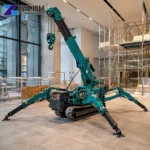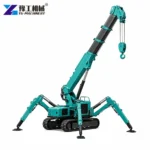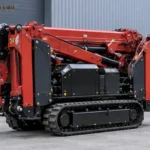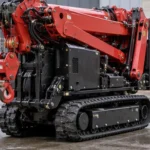
A mini spider crane can enter a work area that is difficult for a truck crane to reach, but compact dimensions do not mean that its rated capacity stays constant through every lift. The deciding figure is the permitted load at the boom radius and height where the hook will actually pick and place the item. A mini spider crane for sale should therefore be compared by its working chart and access envelope, not only by the largest capacity printed in a headline.
YG lists the YG-3, YG-5 and YG-8 as 3-ton, 5-ton and 8-ton classes. Those nominal classes identify the machines; they are not a promise that each crane can lift that weight at maximum reach. When comparing a mini spider crane for sale, keep the class label separate from the load available at the working position. The ranges below show where the published data are paired and where a buyer must use the specific load chart rather than infer a missing end-reach load. See YG’s mini spider crane specifications and the related restricted-access lifting guide.
What Does a Mini Spider Crane Do on a Restricted Site?
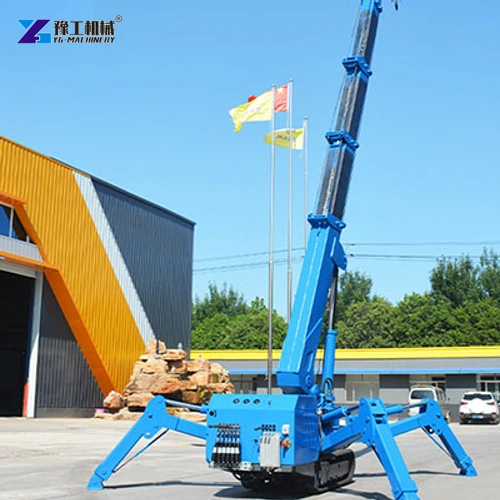
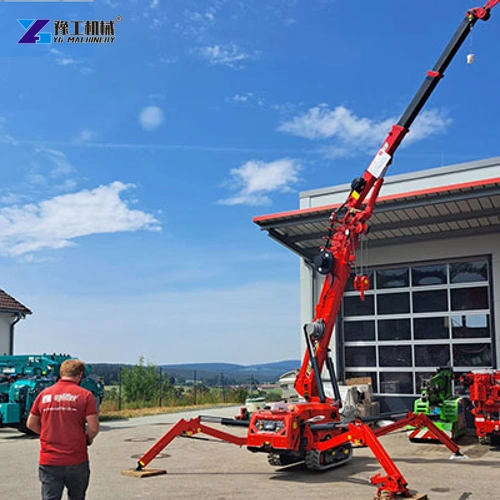
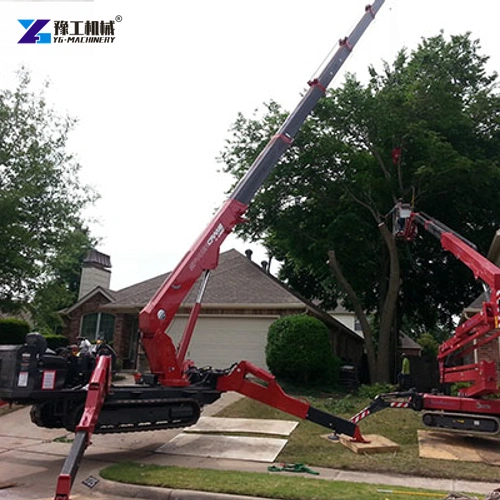
The crawler undercarriage carries the machine through a narrow route, and the stabilizers create a supported working base once it is in position. A hydraulic telescopic boom then raises and slews the load toward the landing point. This arrangement is useful for placing glass, construction materials or maintenance components in courtyards, interior renovation areas and other locations where access for a larger crane is constrained.
The machine does not remove the need to plan the lift. A doorway can be wide enough for the crane while the boom still lacks room to clear a ceiling, pipe rack or façade. The floor or ground must also support the crane and its stabilizer reactions. Work space should include the machine footprint, stabilizer extension, boom swing and a clear route for the suspended load.
A lift plan must keep the load inside the chart during pickup, slew and placement. As the hook moves outward, working radius can increase and permitted capacity can fall. Mark the complete path on a plan and side elevation before selecting the crane.

Read the Working Radius Before Comparing Rated Capacity
Working radius is the horizontal distance from the crane’s slewing centre to the suspended load. Measure it at the intended load position, and include any offset created by the hook block, rigging or a landing point beyond the wall. A load that starts near the machine and finishes farther away may cross more than one chart zone during a single lift.
YG publishes paired end-reach figures for the YG-3 and YG-5: 8.83 m with 0.15 t for the YG-3, and 14 m with 0.5 t for the YG-5. These paired values make the change between nominal class and long-reach capacity visible. For the YG-8, the listed maximum radius is 16.5 m, but that table entry does not pair the radius with a load; do not calculate or assume a capacity from the 8-ton class.
Before selection, mark the pick point, the farthest point of travel and the final set-down point. Then compare each position with the manufacturer’s load chart for the exact stabilizer and boom arrangement. If the required chart row is not available, request it from the supplier rather than treating an unpaired maximum reach as a safe working load. That chart check is the decisive step when selecting a mini spider crane for sale for a specific lift.
- Use the heaviest complete lifted assembly, including any attachment that remains suspended.
- Measure radius from the crane’s slewing centre, not from the edge of the chassis.
- Check the chart through the whole swing path, not only at the pickup point.
If you have the load weight and farthest hook radius, those two values identify which chart rows need to be checked for the YG-3, YG-5 or YG-8.


YG-3, YG-5 and YG-8 Mini Spider Crane Parameters
The following table keeps nominal class, paired reach data and the transport envelope tied to each published model. The YG-8 maximum radius is shown without an end-load value because the source table does not pair those figures.
| Parameter | YG-3 | YG-5 | YG-8 |
| Nominal capacity class | 3 t | 5 t | 8 t |
| Published maximum working radius | 8.83 m with 0.15 t | 14 m with 0.5 t | 16.5 m; paired load not stated |
| Maximum above-ground head | 9.9 m with 0.7 t | 16.8 m; paired load not stated | 18 m; paired load not stated |
| Transport dimensions (L × W × H) | 2,950 × 980 × 1,560 mm | 5,000 × 1,500 × 1,900 mm | 5,000 × 1,600 × 2,180 mm |
| Machine weight | 2,700 kg | 6,200 kg | 7,200 kg |
Transport dimensions decide whether the crane can reach its setup position; the working chart decides what it can lift. These checks are separate: a machine may pass through an entrance but lack capacity at the far side, or meet the chart yet fail to fit the route.
A remote-control option is listed for the range, but confirm the exact supplied configuration and operating method on the quotation. Do not assume an optional control, stabilizer arrangement or lift accessory is included in every machine offer.
Plan the Route, Stabilizers and Landing Point as One Lift
The travel route should be checked for clear width, overhead height, floor transitions, slope and turning room. A compact tracked crane can move across an appropriate site surface, but the access path still has to suit its transport dimensions and total mass. Protecting a finished floor or crossing a service trench may require a route plan approved for the site rather than a guess based on the machine’s compact appearance.
At the work position, check that the stabilizers can be deployed without blocking an escape route or standing on a weak cover, suspended slab or unsupported fill. A level, firm base is important because the crane’s supported geometry is part of its lifting configuration. Confirm the clear area needed for the boom to slew and for the load to pass without contacting glazing, scaffolding or live services. For buyers evaluating a mini spider crane for sale, this setup footprint is as important as the transport width.
For example, a contractor placing glass through an upper opening must consider entry clearance, stabilizer footprint, panel dimensions and rigging, and final-set radius. The lift plan may favour a smaller model with a shorter route or a larger model with a chart-supported load. Decide from the full path and load chart together.
Share the load weight, dimensions, pickup and landing positions, and narrowest access point to compare the published model envelopes against the actual lift.


Mini Spider Crane For Sale FAQs
No. The tonnage is the nominal class, not the allowable load at every radius. YG pairs the YG-5 maximum 14 m reach with 0.5 t; the exact lift must still be checked against the load chart for the crane setup.
The product table lists a maximum reach of 16.5 m but does not pair that figure with an end-reach load. Do not infer the load from the 8-ton class; request the chart for the required radius and boom arrangement.
It depends on the opening and the selected model’s transport dimensions. Compare the full length, width and height with the narrowest doorway and route, including turns and overhead obstacles.
Provide the heaviest lifted assembly, pickup and landing points, required hook height, travel route, floor or ground conditions and available stabilizer area. Those details identify which model chart and setup need checking.
They are used for compact-site lifting such as placing glazing, moving construction materials and maintenance components, and working in courtyards or interior renovation areas where access restricts larger cranes. The task still needs a chart-verified lift plan.
Choose the Crane From the Lift, Not the Largest Number
For a mini spider crane for sale, compare the machine’s access dimensions with the site route, then verify the lifted load at the farthest radius and height. The YG-3, YG-5 and YG-8 figures help shortlist a class, but only the matching load chart can confirm the working position.
For model guidance, include the heaviest load, working radius, hook height, route width and stabilizer area.