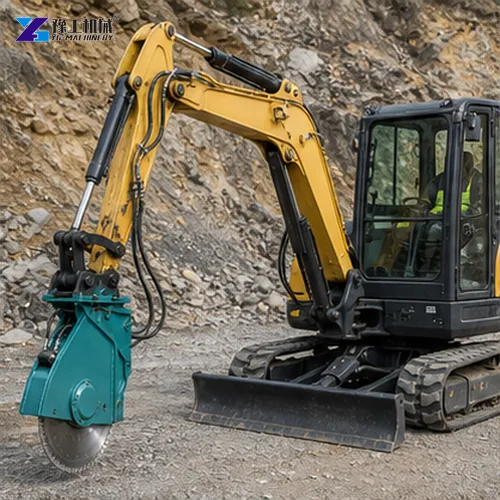
An excavator rock saw is a hydraulic attachment for sawing a controlled kerf along a planned line in material approved for the selected disc. The four YG model classes are listed in the table; carrier weight is only an initial filter, not proof of compatibility. Check the excavator’s attachment circuit, mounting interface, required cut profile and material before selecting a model.
YG Excavator Rock Saw Technical Parameters
Use the model rows to compare carrier class, disc size and the listed cut envelope. Do not interpolate between carrier classes or treat a weight-band match as confirmation that the hydraulic circuit and mounting interface fit.
| Model | YG-CF1 | YG-CF2 | YG-CF3 | YG-CF4 |
| Suitable for excavators | 2~4T | 6~9T | 10~18T | 20~30T |
| Saw Disc Diameter | 0.4~0.8M | 1.2~1.6M | 1.8~2.2M | 2~2.8M |
| Cutting width | 5mm | 9mm | 14mm | 20mm |
| Cutting depth | ≤400mm | ≤800mm | ≤1100mm | ≤1400mm |
| Pressure | 30Mpa | 30Mpa | 30Mpa | 30Mpa |
| Flow | 30L/min | 80L/min | 120L/min | 190L/min |
The listed model values are selection data, not a promise that every carrier in a weight band can power the attachment. Confirm the host machine’s measured flow, pressure, return arrangement, couplers and duty cycle against the selected model before ordering.
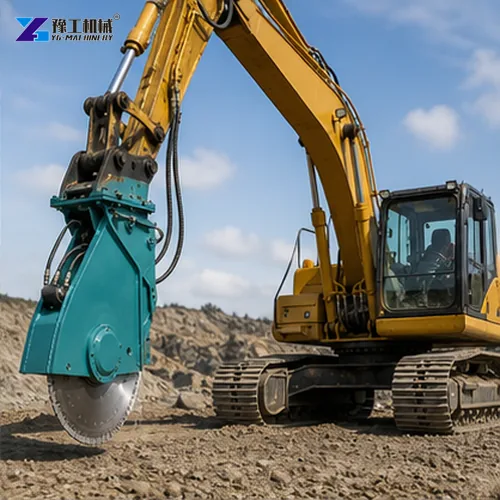
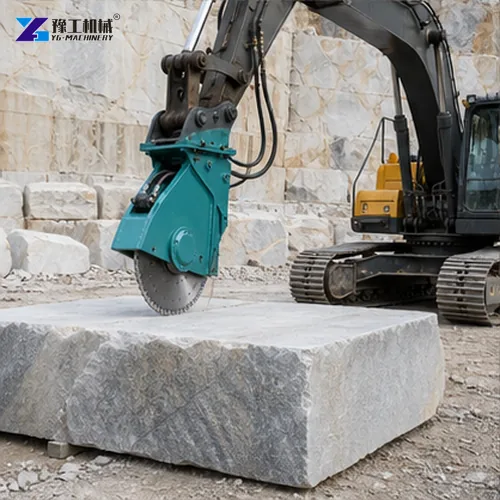
What Is an Excavator Rock Saw?
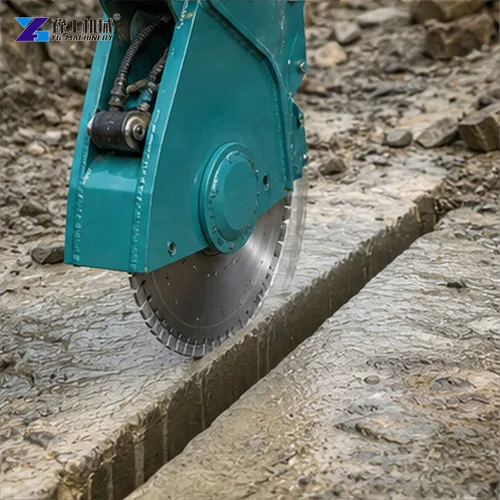
An excavator rock saw uses a circular disc to establish a kerf or profile in a planned cut. A breaker fractures material by impact; sawing follows the disc path, and the cut material may still need to be removed separately. The result depends on the specified disc, material and operating method, so the model name alone does not establish suitability or finish quality. For projects comparing a disc cut with a milling approach, see the <a href=”https://ygproduct.com/drum-cutter-attachment-controlled-excavation-guide/”>excavator drum cutter selection guide</a>.
How Does an Excavator Rock Saw Work?
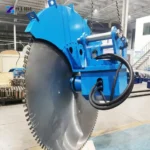
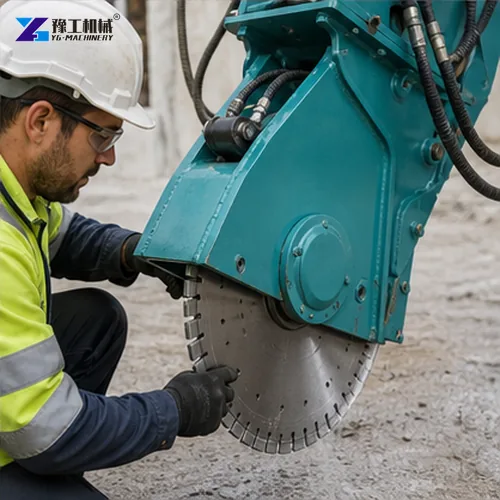
The mounting bracket transfers the attachment load to the carrier; the hydraulic motor and gearbox drive the disc. Confirm the pin or coupler interface, attachment circuit and guarding shown for the ordered configuration. The component list below describes the assembly, while the model-specific values remain in the table.
- Circular disc and segments: select the disc specification for the material, cut profile and required clearance.
- Hydraulic motor: converts the carrier’s supplied hydraulic power into rotation; confirm the selected model’s requirements in the table.
- Gearbox: transfers motor rotation to the disc; verify the assembly and service instructions for the ordered model.
- Mounting bracket: connects the attachment to the excavator; match pin dimensions or coupler interface before shipment.
- Protective guard: check the supplied guard, operating clearances and required work-zone controls in the equipment instructions.
The carrier’s attachment circuit supplies hydraulic energy to the motor, and the drive turns the circular disc. The operator positions the tool on the approved cut line and advances it within the selected model’s limits. Disc choice, feed, cooling or dust controls and permissible materials must follow the disc specification, machine instructions and site method; the sequence does not guarantee a particular cut rate or surface finish.
Where Is an Excavator Rock Saw Used?
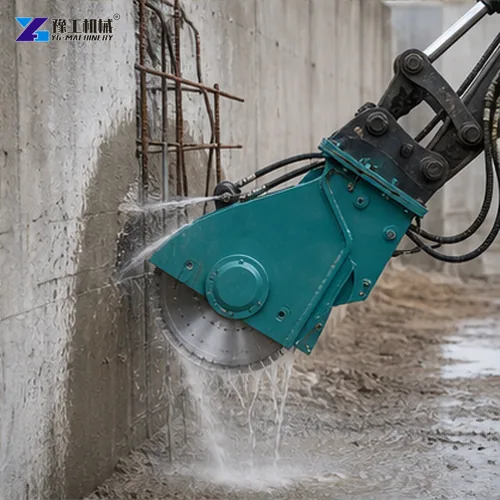
The illustrations show possible evaluation contexts, not verified YG customer installations or approval for every material. Before specifying the attachment, define the cut geometry, material condition, access and required work method:
- Trenching for pipelines and cables. It creates a neat, narrow trench in hard soil and rock.
- Foundation and basement excavation. It cuts perimeter walls and footings without damaging surrounding areas.
- Quarrying and mining. It makes clean cuts for stone blocks and removes overburden precisely.
- Road and bridge work. It cuts through asphalt, curbs, and reinforced concrete safely.
- Tunnel profile trimming. It shapes tunnel walls and floors with high accuracy.
- Underwater cutting in shallow areas. With proper seals, the saw operates in water to cut rock or concrete.
For asphalt, reinforced concrete, underwater work or material containing embedded objects, obtain explicit confirmation of the disc, attachment configuration and operating method. Do not assume one saw disc covers every material or environment.
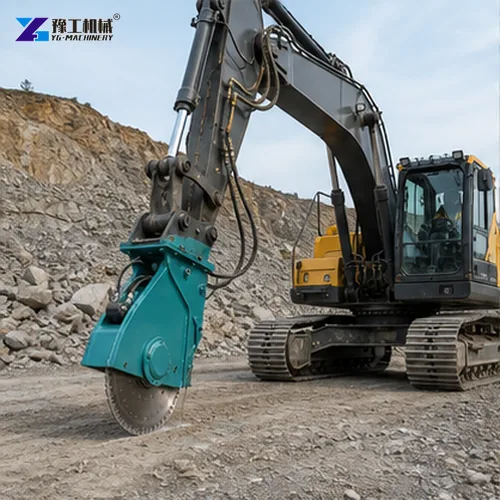
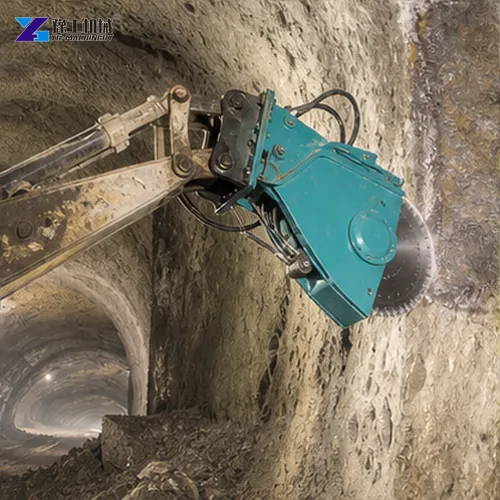
What Should Buyers Check Before Ordering an Excavator Rock Saw?
Use these checks to decide whether a listed model is a candidate for the project:
- Carrier fit: compare the excavator’s operating weight with the listed class, then confirm the hydraulic circuit and mounting interface.
- Cut geometry: compare the required depth and width with the model table and drawing; confirm approach clearance and any multi-pass requirement.
- Material match: specify rock type, concrete reinforcement or other material details so the disc and method can be checked rather than assumed.
- Hydraulic match: verify measured flow, pressure, return conditions, couplers and duty cycle against the exact model.
- Service scope: confirm inspection points, disc replacement procedure, wear parts and maintenance intervals in the manuals for the supplied assembly.
- Site controls: agree the cut line, guarding, exclusion area and any water or dust-control method with the site plan.
- Documentation: request the configuration drawing, operating instructions, inspection records and applicable warranty terms for the quoted unit.
Excavator Rock Saw FAQ
These answers use the published model table and identify information that must be confirmed for a specific excavator or material.
Answer: The table does not list a 5-ton carrier class, so do not assume an adjacent model fits. Send the excavator make and model plus attachment-circuit data for confirmation.
Answer: Treat the table’s cutting-depth row as the published model limit, not a guaranteed result on every site. Material, disc clearance, approach angle and pass sequence also affect the cut; share the cut section for review.
Answer: The table does not specify material compatibility. Provide the material and reinforcement details and obtain confirmation of the disc and operating method. Do not assume one disc covers rock, concrete and asphalt.
Answer: Match the replacement to the exact attachment model, disc interface, dimensions, segment specification and intended material. Confirm the part with the supplier rather than assuming discs are interchangeable.
Answer: Inspect the disc and segments, fasteners, guard, mounting interface and hydraulic hoses in accordance with the supplied manuals. Stop and have damage assessed; use the specified water or dust controls for the disc and site.
Request an Excavator Rock Saw Configuration Review
YG lists four excavator rock-saw models on this page. The table is the source for the model values; mounting hardware, accessories, availability and material compatibility must be confirmed for the ordered configuration.
Besides the excavator rock saw, we produce a full range of attachments. Our catalog includes twin-cylinder shears, pile drivers, drilling and splitting machines, drum cutters, vacuum lifters, pile breakers, hydraulic breakers, crusher buckets, pulverizers, compactors, rippers, demolition shears, and car dismantling grabs. This means one reliable partner for all your excavator tool needs.
For a model review, send the excavator make and model, operating weight, attachment-circuit supply and return details, coupler or pin drawing, material, cut profile and required depth. These inputs let the team check the listed configuration without assuming an unsupported fit.