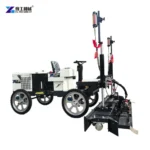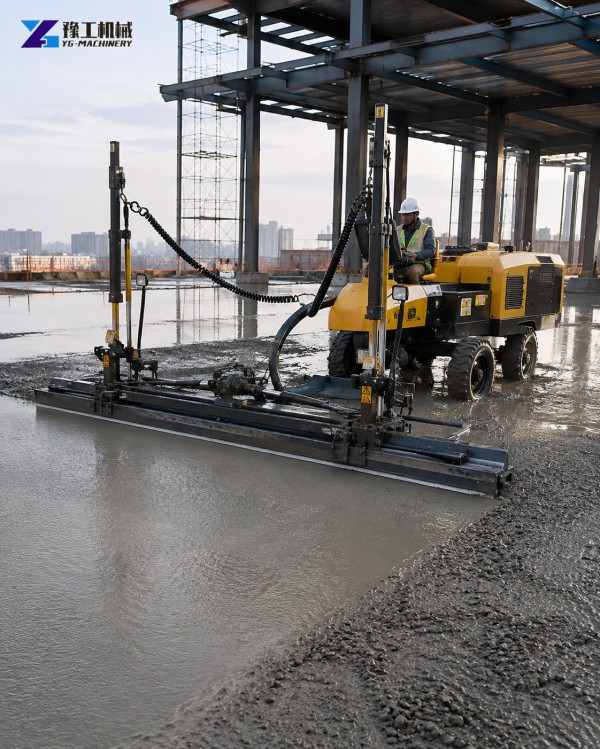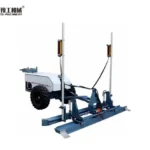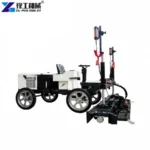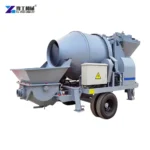
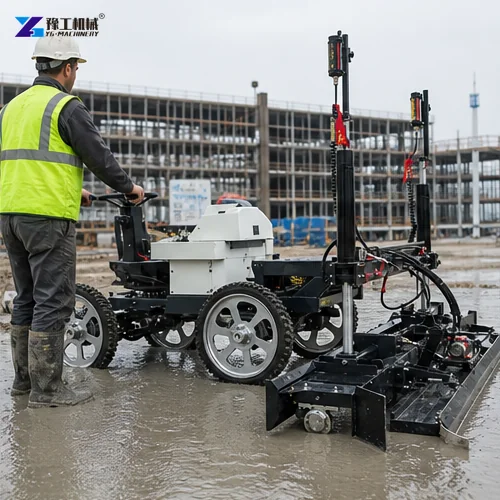
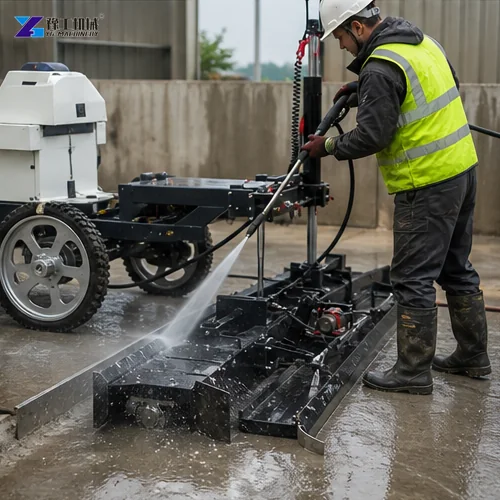
A concrete floor leveling machine uses a controlled screed head to bring freshly placed concrete toward the planned elevation. For warehouse slabs, the useful comparison is how the head control, travel arrangement and concrete supply work together across the pour. YG offers walk-behind configurations with different drives and adjustment systems; the completed floor also depends on placement, edge work, finishing and curing.
Below are the technical specifications for our four walk-behind models. You can compare and select the best concrete floor leveling machine for your project.
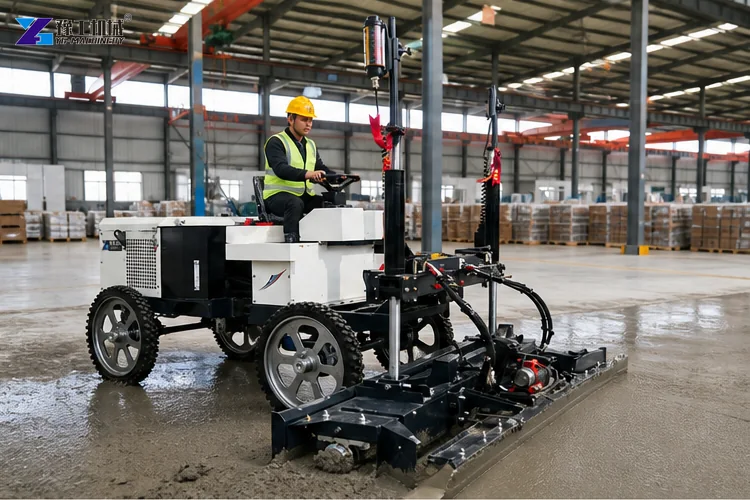
Concrete Floor Leveling Machine Parameters
| Model | YGJX31 | YGJX32 | YGJX33 | YGJX34 |
| Engine | ||||
| Model | Generator set | GX390 Electric start | GX390 Electric start | GX390 Electric start |
| Power | 2.0kW | 13hp/3600rpm | 13hp/3600rpm | 13hp/3600rpm |
| Fuel tank (L) | 14.5 | 6.5 | 6.5 | 6.5 |
| Running device | ||||
| Drive | Motor | Hydraulic motor | Hydraulic motor | Hydraulic motor |
| Running mode | Infinitely variable speed | Handle control, stepless speed | Handle control, stepless speed | Handle control, stepless speed |
| Running speed(m/min) | 0-36 | 0-45 | 0-65 | 0-45 |
| Suggest working speed(m/min) | 5 | 5 | 5 | 5 |
| Screed head | ||||
| Type | Self-leveling | Electric control, self-leveling | Self-leveling | Hydraulic control, self-leveling |
| Width | 2500mm | 2500mm | 2500mm | 2500mm |
| Exciting force | 500N | 500N | 500N | 500N |
| Vibration frequency | 50Hz | 50Hz | 50Hz | 50Hz |
| Laser control system | ||||
| Control type | Microcomputer laser scan | Microcomputer laser scan | Microcomputer laser scan | Microcomputer control |
| Operation mode | Walk-behind | Walk-behind | Walk-behind | Walk-behind |
| Forward and reverse | Handgrip control, stepless speed-walking | Hydraulic control | Handgrip control, stepless speed-walking | Hydraulic control |
| Size and weight | ||||
| Working size(mm) | 2758*2622*1980 | 2740×2659×1980 | 2578×2643×1980 | 2780*2622*1980 |
| Weight(kg) | 295 | 365 | 380 | 410 |
Compare the power, travel and head-control arrangement against your warehouse pour layout.
Concrete Floor Leveling Machine Selection for Warehouse Slabs
All four configurations use a 2,500 mm screed head, but their drive and head-control arrangements differ. YGJX31 is listed with a generator set and drive motor; YGJX32, YGJX33 and YGJX34 use GX390 electric-start engines with hydraulic travel. YGJX32 has electrically controlled self-leveling and YGJX34 has hydraulically controlled self-leveling. The adjustment system, travel control and service access are useful distinctions when the working width is the same.
A combustion-engine generator produces exhaust even when it powers an electric drive. Moving the motor onto the machine does not make the generator an emission-free indoor power source. An enclosed warehouse requires a suitable power and ventilation arrangement, with combustion equipment positioned and operated according to its instructions and the site assessment.
A wide open bay allows long, regular passes, while column grids and narrow strips interrupt travel. The machine must turn and reposition without damaging completed work or disturbing reinforcement. Compare the planned pour width with the head width, then examine how the operator reaches edges and exits the pour. The fastest listed travel setting has little value when repositioning dominates the placement.
The table distinguishes travel speed from the suggested working speed. Multiplying speed by head width produces a geometric sweep area, not a finished-floor production rate: it ignores overlapping passes, concrete supply, head corrections and edge work. For a warehouse proposal, relate machine movement to the concrete delivery sequence and the crew completing the surface.
Main Components and Working Principle of a Concrete Laser Leveling Machine
A concrete laser leveling machine consists of six main components. Each plays a vital role in the screeding process.
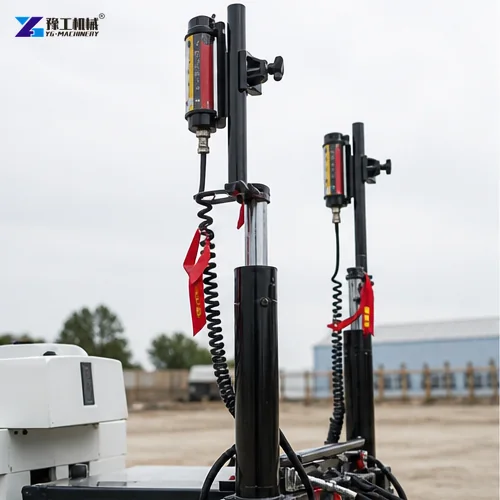
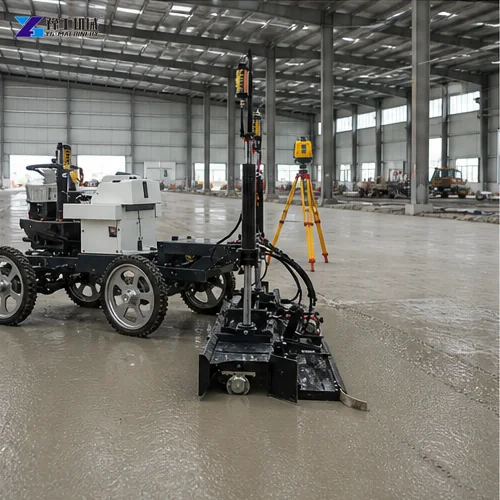
- Laser Transmitter: This device sits on a stable tripod and emits a rotating laser beam. The beam sets the reference plane for the entire floor.
- Laser Receiver: Mounted on the screed head, the receiver catches the laser signal. It detects any deviation from the target height.
- Control System: The microcomputer control panel processes the signal. It sends precise commands to the leveling actuators.
- Actuators: Electric or hydraulic actuators respond to the commands. They raise or lower the screed head automatically.
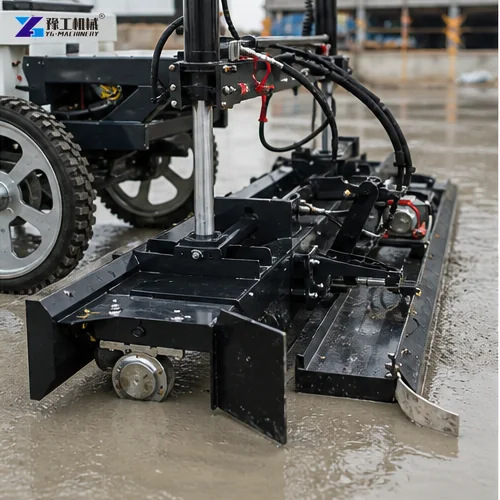
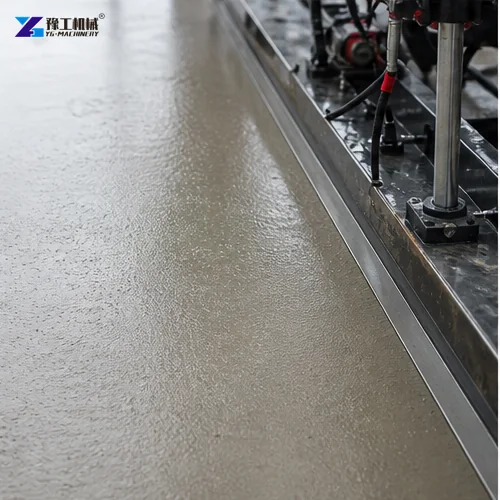
- Vibrating Screed Head: This part compacts and levels the wet concrete. The vibration eliminates air pockets and increases density.
- Drive System: The drive motor or hydraulic motor moves the machine forward. You control the travel speed steplessly with the handle.
The transmitter establishes a reference plane, and the receiver on the machine detects its height relative to that plane. The controller and adjustment mechanism correct the screed head while the operator advances through freshly placed concrete. A stable transmitter position and an unobstructed signal are therefore part of the control system, not incidental accessories.
The head brings the fresh surface toward the set elevation while vibrating the concrete at the working face. That operation does not finish every edge or establish the final hardened-floor flatness by itself. Placement consistency, overlapping passes, edge work, finishing and curing all influence the completed slab. Moving the transmitter or losing its signal requires the reference to be checked before continuing.
Laser Grade Control and Warehouse Floor Acceptance
Levelness describes elevation relationships, while local flatness concerns changes over shorter distances. The project specification determines what is measured, where and when it is measured, and which acceptance procedure applies. A laser-guided screed establishes a working reference during placement; acceptance of the hardened slab still requires the specified assessment.
If the concrete arrives unevenly, the head may face a mound on one pass and a shortage on the next. Pre-spreading to a manageable depth helps the adjustment system work within a consistent load. Finishing equipment must then follow at the appropriate concrete condition. Extra screeding passes cannot substitute for missing concrete or correct a poorly timed finishing operation.
Share the slab layout and its specified elevations so the working reference can be discussed.
Laser Concrete Leveling Machine Construction Process
The construction process follows a clear sequence. Each step contributes to a high-quality floor.
- Site Preparation: Clean the subgrade thoroughly. Then set up the laser transmitter on a firm tripod. Check that its signal covers the entire pour area.
- Concrete Pouring: Pour the concrete mix slightly above the target grade. Use a rake or spreader to distribute it evenly. This reduces the screeding load on the machine.
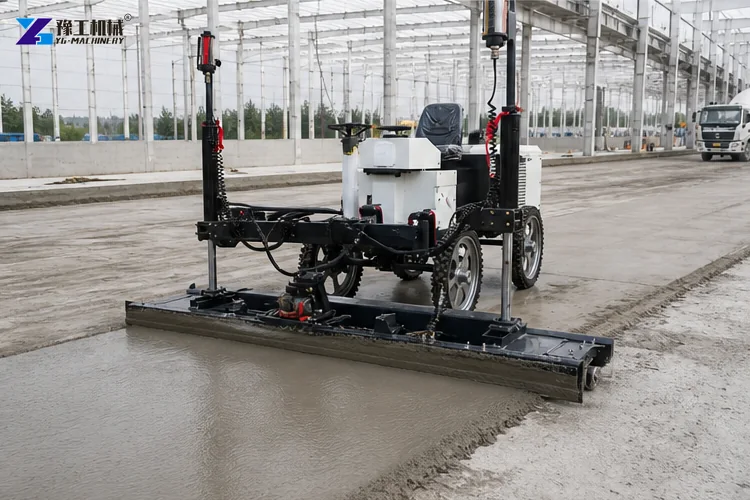
- Laser Screeding: Start the machine. The receiver tracks the laser plane automatically. The screed head vibrates, levels, and compacts the concrete in one pass. This method drastically cuts manual labor.
- Manual Touch-Up: After machine screeding, workers use straightedges and floats. They focus on edges, columns, and corners. This ensures no low spots remain.
- Curing: Apply a curing compound or cover the slab with plastic sheets. Proper curing prevents cracking and builds long-term strength. Your floor then gains superior durability.
At columns, door thresholds and perimeter strips, plan the handoff between the machine and edge crew before starting the bay. The screed head needs enough space to pass without striking an obstruction, and workers need access to finish the strip it leaves. Keep the reference elevation consistent across that handoff so an apparently smooth edge does not create a step at the next pour.
Fuel consumption and hourly coverage depend on engine load, travel pattern and interruptions. Use the engine and machine instructions for servicing, and assess production through a representative placement sequence. A continuous supply and an accessible rectangular bay produce a different duty pattern from small isolated pours, even with the same machine.
Application Areas of Automatic Concrete Leveling Machines
You can use an automatic concrete leveling machine in many demanding locations. Each setting benefits from the high flatness these machines deliver.
- Warehouse and logistics slabs: the laser reference helps control elevation across accessible pours. Floor-flatness and levelness acceptance must be specified and tested for the project; a machine selection alone does not guarantee an FF or FL result.
- Factory workshops: coordinate concrete delivery with unobstructed passes between columns, bases and embedded services. Areas the screed head cannot reach require a planned edge-working method.
- Shopping and exhibition areas: a controlled initial surface supports subsequent finishing, but joint layout, finish timing and curing still influence appearance and serviceability.
- Hangars and parking areas: follow the specified elevations, slopes and joint details. Do not assume one horizontal laser setting suits every drainage or transition requirement.
- Cold-storage floors: coordinate the slab with insulation, reinforcement and joint details. The screeding operation is one part of the floor system rather than a guarantee against cracking or moisture problems.
Include column spacing, edge strips and concrete delivery when planning the placement sequence.
YG Advantages of Concrete Floor Leveling Machines
Why do contractors choose YG Machinery? We combine strong engineering with practical support.
- Configuration choice: compare drive, travel control and screed-head adjustment against the warehouse layout and placement method. Keep the controls and power arrangement matched to the exact model.
- Grade reference: laser receivers and controls support height adjustment while the head is working. Calibration and a stable reference plane are necessary for useful control.
- Operator access: the walk-behind arrangement allows direct control of travel, but turning space, reinforcement and freshly placed concrete affect the working route.
- Service planning: inspect the head, hydraulic connections where fitted, drive components and receiver mounting. Cleaning after placement prevents concrete build-up from obstructing adjustment.
- Delivery and commissioning: confirm the current configuration, accessory list, delivery date and training scope with the order. Availability and operator learning time depend on the actual package.
- Ongoing support: identify the machine and its power/control equipment when ordering wear parts or requesting service. A clear model and serial record helps distinguish similar-looking configurations.
Confirm the model, accessories and service scope for the proposed installation.
FAQ About Concrete Floor Leveling Machines
For the placement sequence and crew handoffs, see the pour preparation guide.
No. Laser control guides the screed head during placement. Final floor acceptance also depends on the concrete, placement, finishing, joints and curing, and must be assessed using the project specification.
The table lists YGJX31 with a generator set and drive motor, while YGJX32–34 use GX390 electric-start engines and hydraulic travel. Head-control arrangements also differ, so compare the complete model rather than working width alone.
No. A combustion-engine generator produces exhaust. The power source, exhaust position and ventilation require an appropriate site arrangement and compliance with the equipment instructions.
No. Pass overlap, concrete delivery, turning, edge work and finishing interrupt the geometric sweep area. Estimate output from the complete placement sequence rather than speed multiplied by width.
Check travel access, clearances and the working route against the actual slab design. Plan how edges and areas beyond the head reach are completed without displacing reinforcement or changing the reference elevation.
YG Machinery – Your Professional Concrete Floor Leveling Machine Manufacturer
YG Machinery specializes in concrete floor leveling machines and a wide selection of construction equipment. Besides laser screeds, we supply horizontal directional drills, generator sets, hydroseeders, backhoe loaders, wheel loaders, mortar spraying machines, GRC spraying machines, line marking machines, brick making machines, rollers, crack sealing machines, EV chargers, spider cranes, piling rigs, and rotary drilling rigs. We are your one-stop partner for reliable machinery. Contact us today for a free quote or detailed product catalog. Our team is ready to support your next project.
Describe the warehouse slab, concrete placement arrangement and preferred screed configuration for a product proposal.