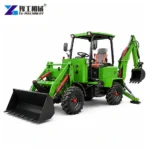
A utility trench produces two kinds of work: excavation below ground and movement of loose material above it. A backhoe loader addresses those jobs with different working ends. The rear boom, dipper and bucket excavate from a supported position; the front loader picks up, carries and discharges material. The benefit is not that both buckets do the same job, but that the machine can change roles as the work progresses.
If you are comparing a tractor loader backhoe for sale, start with that complete-machine arrangement. This article concerns a construction backhoe loader with both front loading and rear excavation equipment, not a small front-only loader or a rear attachment sold separately for a farm tractor. The 420F configuration below gives a concrete example of how the two ends contribute to trench and material-handling work.
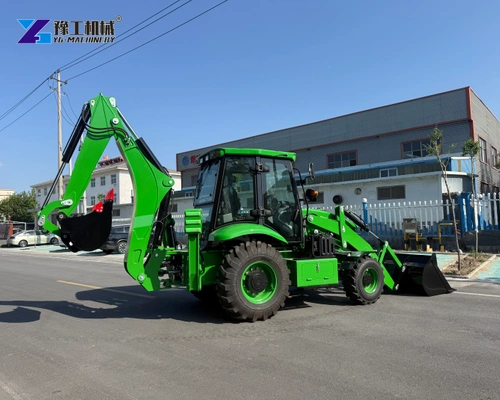
Rear Excavation: Opening and Extending a Trench
The rear attachment reaches into the excavation and draws the bucket toward the machine through the movement of its boom and dipper. After filling, the arm raises and swings to discharge spoil beside the cut or into an appropriate receiving area. The operator repeats that cycle while controlling the trench profile, then repositions the machine when the next section is outside a suitable working reach.
Drainage connections, water-service trenches and small foundation excavations are examples of work that can combine this repeated digging cycle with material handling. Each has a different finished profile: a service trench follows a route and level, while an isolated excavation requires control of its perimeter and bottom. The rear bucket’s volume alone does not describe how well the complete machine fits either task.
For a tractor loader backhoe for sale, maximum digging depth and rear swing are especially relevant here. Depth describes the lower working envelope; swing concerns movement of the rear assembly across the working area. Neither is a guarantee of trench output per hour. Soil behavior, the required profile, obstructions and safe spoil placement all influence the working cycle. Existing utilities must be located and the excavation planned before machine digging begins.
Share the trench dimensions and access conditions to discuss the rear excavation requirement.
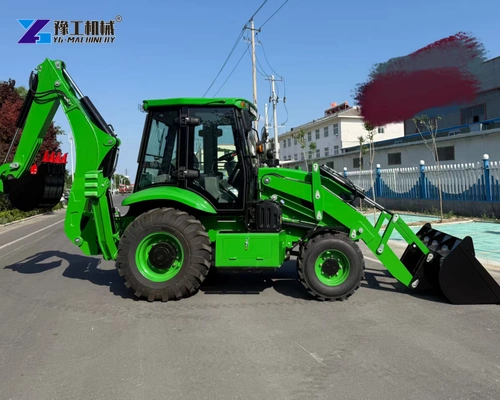
Front Loading: Clearing Spoil and Returning Backfill
Excavated material can obstruct access long before the rear attachment reaches its depth limit. The front bucket gives the same machine a separate role in clearing loose spoil, gathering stockpiles and loading suitable receiving vehicles. It approaches the material from ground level rather than reaching down with an articulated digging arm. That makes repeated pickup, short travel and discharge a different motion from trench excavation.
The distinction becomes useful during reinstatement. Selected material can be brought back to the excavation and placed in the intended area without treating the rear bucket as the only handling tool on site. A tractor loader backhoe for sale is therefore worth considering for a job that alternates between digging and loose-material movement, rather than only for its largest bucket dimension.
Backfilling is not the same operation as compaction. Material still needs to be placed in accordance with the construction requirements, and the specified compaction method remains a separate task. A loader bucket should not be represented as providing a verified compacted result simply because it can deliver or spread soil. Likewise, lifting capacity and bucket volume answer different questions: a larger volume does not permit unrestricted material weight.


420F Tractor Loader Backhoe Configuration
| Specification | 420F Backhoe Loader |
| Operating weight | 7300 kg |
| Transport dimensions | 7560 × 2360 × 2900 mm |
| Minimum ground clearance | 300 mm |
| Front bucket capacity | 1.0 m³ |
| Rated loading capacity | 2000 kg |
| Front breakout force | 54 kN |
| Discharge height | 2700 mm |
| Discharge distance | 1015 mm |
| Rear bucket capacity | 0.3 m³ |
| Maximum digging depth | 4010 mm |
| Rear attachment swing | 190° |
| Engine | Cummins 4BT3.9-C100 |
| Rated engine power | 75 kW |
| Rated engine speed | 2400 r/min |
| Hydraulic system pressure | 20 MPa |
| Transmission | 2 forward / 2 reverse gears |
| Maximum travel speed | 28 km/h |
The figures belong to this complete configuration. In particular, 4010 mm concerns rear excavation, while 2700 mm concerns front discharge; exchanging those measurements would misdescribe the two working ends. The 1.0 m³ front bucket and 0.3 m³ rear bucket also serve different movements. They should not be added together as a combined production capacity.
When assessing a tractor loader backhoe for sale, use the dimensions and operating weight alongside those attachment figures. The complete chassis must reach and work at the excavation, not just have a bucket capable of reaching the required point. Photographs show backhoe-loader configurations and component arrangements; their paint colors do not establish a particular model specification.
Compare the 420F parameters with the loading and excavation work required on your site.
Stabilizers, Controls and Changing Working Position
Rear digging applies forces through an attachment extending away from the chassis. Stabilizers provide support as part of the machine’s designated excavation setup. Their contact with the ground matters as much as their presence on the equipment: weak fill, unsupported trench edges and unsuitable bearing surfaces cannot be made safe merely by extending a leg. Setup must follow the machine instructions and the site’s ground assessment.
The cab also serves two working directions. Road and loader visibility are different from the view needed to follow the rear bucket and discharge area. Controls and operator position should support the selected task without relying on someone standing inside an attachment’s movement zone. Cab photographs are useful for understanding the operator environment, but a control’s appearance is not an operating instruction.
Changing from excavation to travel is a distinct transition. Attachments and supports need to be placed in their designated travel positions before the machine moves. This is why a tractor loader backhoe for sale should be evaluated as a working sequence, not as two simultaneous operations. A job involving constant long-distance hauling or uninterrupted deep excavation may call for different equipment alongside it.
Send the proposed working position, support restrictions and operator access for a setup discussion.


Where a Tractor Loader Backhoe Fits the Work Sequence
On a utility connection, the rear attachment can excavate the planned service trench while the front loader handles loose material and helps clear the working area. After the service installation and required inspections, the loader can return suitable backfill. The combination is relevant because the work changes character during the project, not because one bucket replaces every tool needed for underground construction.
Drainage maintenance often combines local excavation with removal of accumulated loose material. Access to the inlet, pipe or damaged section may favor a rear digging arm, while material cleanup favors the front bucket. Where the work is mainly repetitive stockpile loading, a dedicated loader may be the more direct comparison; the earthmoving equipment guides cover related machine tasks.
For property development and small building sites, a tractor loader backhoe for sale can be considered for localized foundation excavation, service routes and movement of loose aggregate or soil. The actual excavation geometry still decides suitability. A trench bucket’s reach should not be extended into a claim that the machine can produce any foundation shape, lift any component or work beside any unsupported edge.
Plan the Machine Route as Well as the Digging Reach
The work area includes the approach, turning space, support positions and spoil or loading area. A machine that fits through an entrance may still lack room to turn or place its stabilizers at the excavation. Its transport length is also not the same as the space swept by a working rear attachment. Allowing for those separate spaces keeps the loading route from interfering with the excavation position.
A useful comparison follows the real job: where the machine enters, where rear digging occurs, where spoil goes and how material returns. For a tractor loader backhoe for sale, that sequence connects the machine’s two attachments to the construction task. It also makes clear when a separate hauler, compactor or different excavation method is needed rather than assigning those functions to the backhoe loader.
Describe the approach route and the relationship between digging, spoil and backfill areas to request a complete-machine proposal.

Tractor Loader Backhoe for Sale FAQs
The front loader handles pickup, short carrying and discharge near ground level. The articulated rear attachment reaches into an excavation and controls the digging cycle below the machine. They perform complementary tasks rather than interchangeable ones.
Placing or spreading backfill does not establish a compacted result. The project still needs its specified compaction equipment, placement method and acceptance checks.
For the 420F configuration, 4010 mm is maximum rear digging depth and 2700 mm is front discharge height. They describe different attachments and should not be substituted for one another.
They form part of the support arrangement for rear digging forces. The correct setup also depends on ground bearing conditions, attachment position and the machine instructions; stabilizers do not remove the need to assess the excavation edge.
This is a complete construction backhoe loader with front loading and rear excavation equipment. A front-only electric loader lacks that rear digging assembly, and its dimensions or capacity must not be substituted into the 420F specification.
Describe the excavation, material-handling work and available site access for a backhoe-loader equipment proposal.