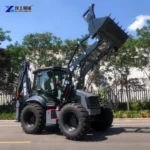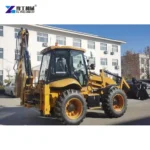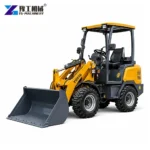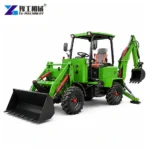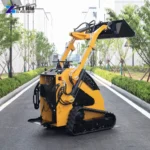
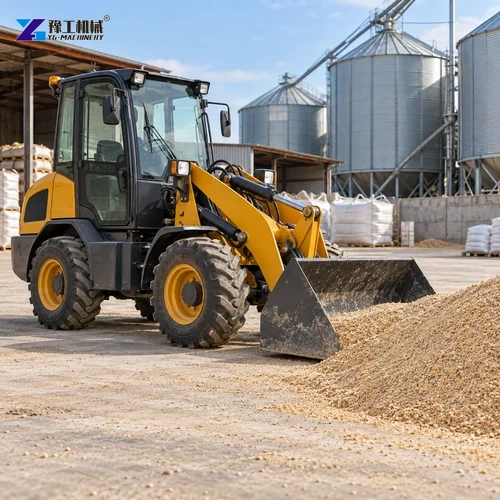
A mini payloader is a compact front-bucket wheel loader for repeated scoop, carry and dump work. It is useful when material needs to move between a stock pile and a nearby receiver, not when the main task is digging a trench or reaching below grade.
The first listed mechanical configuration pairs a 3.2 m dumping height with a 1.8 m bucket width. Those numbers become meaningful when read alongside the material, receiving point and travel surface; the machine’s fit comes from the entire loading cycle, not the word “mini.”
What a Mini Payloader Is Built to Do
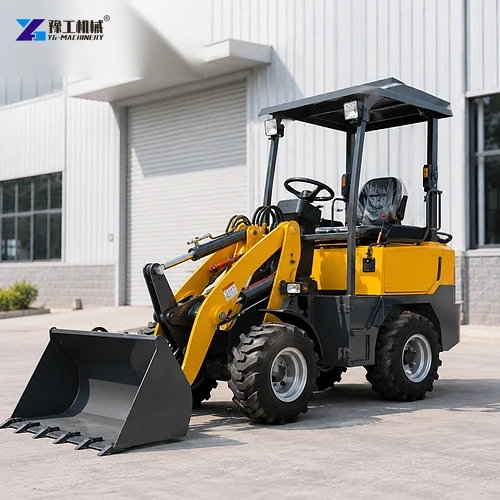
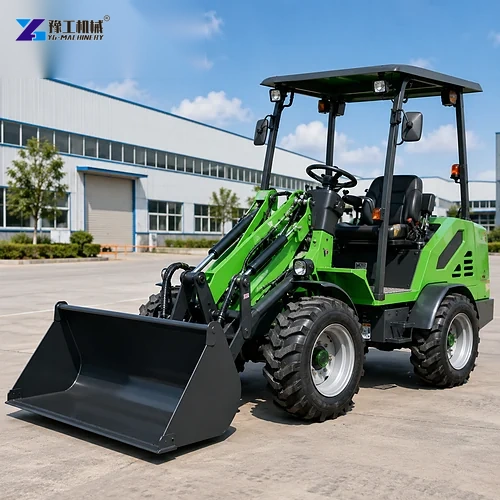
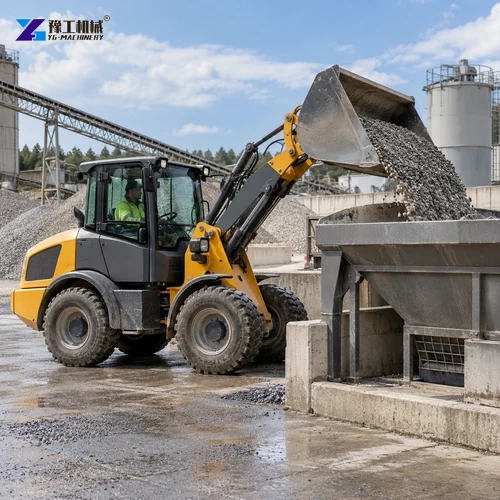
A mini payloader is a compact articulated wheel loader. Its front bucket approaches a pile, gathers loose material, lifts it, carries it over a short route and tips it into a receiving point. That scoop–carry–dump cycle is the machine’s defining job. It can save repeated manual handling where material moves between stock piles, bins, vehicles or work areas, but it is not a small excavator and does not have an excavator’s digging geometry.
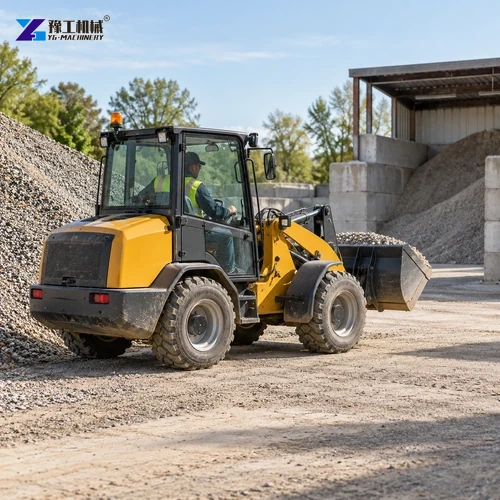
The articulated chassis bends at the centre so the front bucket can be directed through a turn without steering the whole machine like a long rigid vehicle. This is useful in yards where turning space is limited, but the machine still needs a stable travel route and room to approach the pile and receiver. The operator also needs to keep the load low while travelling and raise the bucket only at the point where material is discharged.
For buyers, the useful comparison is not simply “small versus large.” It is whether bucket width, dump height, transmission, axle and tyres match the loading cycle. The listed mechanical configuration is one product option in the YG range; it should be judged from those concrete attributes and the surface on which it will work.
Mini Payloader Applications on Farms, Construction Sites and Yards
On farms, a compact loader can move feed, manure, bedding, soil or other loose supplies between storage and a barn, trailer or mixing point. The short shuttle route matters: the machine repeatedly scoops from one stock location and tips into a low-sided receiver. For baled or palletized goods, a suitable attachment and safe load rating must be confirmed; the standard bucket should not be described as a bale fork or pallet handler.
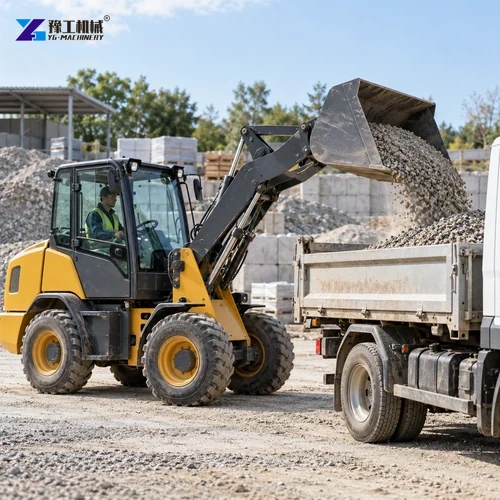
On construction and landscaping work, the front bucket transfers sand, gravel, topsoil and loose demolition debris around a small site. It can supply a mixer or load a trailer where the ground is firm enough for the tyres and the receiving height falls within the machine’s range. In a nursery or grounds-maintenance yard, the same loading cycle can shift soil, mulch and aggregate between storage bays. In a warehouse or stock yard, choose a route with sufficient turning space and floor capacity for the machine and load.
Snow clearing is another possible wheeled-loader task where a suitable bucket or blade is fitted and the surface provides traction. A wet field, deep mud, an unprotected floor or a steep stockpile changes that assessment. The machine’s compact footprint helps with access; it does not remove the need to match tyres, ground and attachment to the job.
- Farm and stable yards: repeated movement of feed, bedding, manure and soil to a nearby receiving point.
- Small construction or landscape sites: short transfers of sand, gravel, topsoil and loose debris.
- Nurseries, depots and warehouses: loading or repositioning stock in lanes that allow safe turns and bucket discharge.
- Snow maintenance: clearing paved lots or access ways when the correct attachment and surface conditions are present.
Mechanical Mini Payloader Parameters for the First Listed Configuration
YG’s product page lists several transmission and axle combinations. This table identifies only the first mechanical-transmission configuration and keeps the associated components together. Because the page does not assign it a separate alphanumeric model code, the official configuration description—not an invented model number—is the accurate name.
| Parameter | Mechanical transmission — first listed configuration |
|---|---|
| Dumping height | 3.2 m |
| Bucket width | 1.8 m |
| Transmission / gearbox | Mechanical / Hi-Lo |
| Drive axle | Isuzu |
| Engine | Weifang 490 |
| Tyre size | 20.5-16 |
| Control lever | Single-lever |
| Brake system | Oil-brake |
| Articulation angle | 25° |
The YG mini payloader range also lists hydrostatic/CVT alternatives with different gearbox, axle, engine, tyre and brake combinations. A buyer comparing columns should evaluate the whole configuration, not select a 3.2 m height from one column and combine it with an unrelated component from another.
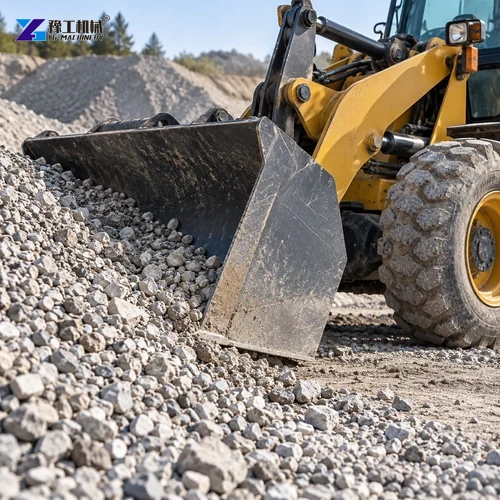
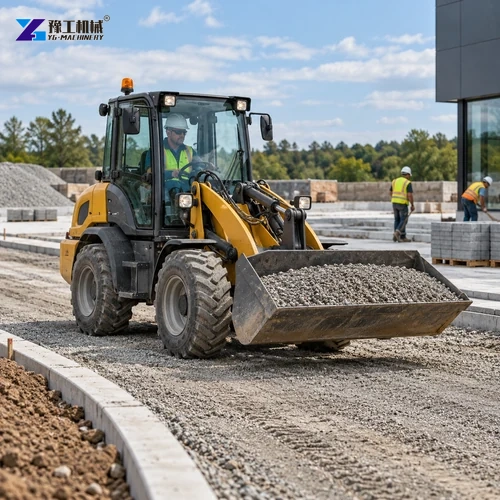
The deciding question is whether the job repeats a front-bucket loading cycle. Compare the stated dump point with the actual hopper, truck or storage edge.
MATCH THE LOADER TO THE MATERIALHow 3.2 m Dump Height and 1.8 m Bucket Width Affect the Loading Cycle
A 3.2 m dump height is relevant when the bucket has to clear the side of a receiving body or place material into an elevated hopper. It is not a statement that every truck wall, bin edge or dumping position is suitable: bucket pivot geometry, approach angle and the location of the machine relative to the receiver matter. Compare the receiving edge with the point at which the bucket actually unloads, and leave room for the machine to turn and reverse safely.
The 1.8 m bucket width describes the bucket dimension, not its volume or rated payload. A wider bucket can cover a broader pile face in one pass, but it also needs room to enter the pile and travel through the work aisle. The material density, moisture and heap shape affect how much weight a bucket can carry; the published width alone cannot be converted into a safe load.
These two figures work together in a cycle. If the receiver is high, the operator needs a controlled approach that avoids striking its edge. If the route is narrow, a wide bucket may limit turning clearance even though it can gather material efficiently. A short loading trial with the intended material and receiver shows whether the machine can fill, travel, turn and tip without repeated repositioning.
When a Mini Payloader Is the Wrong Compact Machine
Choose a loader when the main job is to move material from a pile to a receiving point. Choose an excavator when the task is to dig a trench, work below the machine’s level or reach outward with a boom and arm. A loader bucket can scrape or gather loose material on the surface, but that does not make it a substitute for excavation depth or controlled trench geometry.
A wheeled machine also depends on its route. Mud, loose fill, soft shoulders and steep grades may reduce traction or stability; narrow doors and tight turns can prevent a safe approach even if the machine physically fits through the entrance. The front bucket and carried material change visibility and load distribution, so transport height and operator sight lines matter too.
The mechanical configuration is therefore a practical fit when the work has repeated short transfers, the ground supports wheel travel, and the receiver is reachable within the published loading geometry. If the main requirement is digging, long-distance haulage, lifting a suspended load or work on very soft ground, compare the relevant machine class rather than trying to make a compact loader perform a different job.
Mini Payloader For Sale FAQs
A mini payloader is a compact front-bucket wheel loader for scooping, carrying and tipping loose material over short repeated cycles. It is used for tasks such as farm-yard handling, construction material movement and warehouse or stock-yard loading when access and ground conditions suit a wheeled machine.
The first listed mechanical-transmission configuration has a 3.2 m dumping height and 1.8 m bucket width. These figures describe that column only and do not state payload capacity.
The first configuration is identified by its mechanical transmission and component set. The published table does not provide a separate alphanumeric model code, so the configuration name should be used instead of an invented model number.
No. A payloader scoops and carries material in a front bucket. An excavator uses a boom and arm to dig below grade, trench or place material at reach. Select the machine around the main work cycle, not its compact size.
No. Traction, turning room, ground bearing, slope and material conditions affect suitability. Soft ground, steep gradients, loose edges or a narrow receiving point should be assessed before choosing a wheeled loader.
Request a Project-Specific Quotation
Tell us the product configuration and the work it needs to perform so the team can review the scope against your project.