When you search for directional drilling equipment for sale, the most useful comparison is not a dramatic machine photo or one large force rating. It is a rig whose powerhead, push-pull system, drill string and fluid connections suit the crossing you actually need to complete. A compact utility bore beneath a road and a long pipeline crossing place different demands on the machine and its support package. This guide explains how an HDD rig works, what the listed YG models show, which details still need confirmation, and how to request a configuration that can be compared fairly.
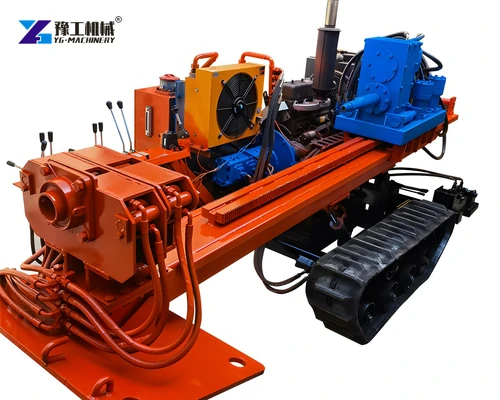
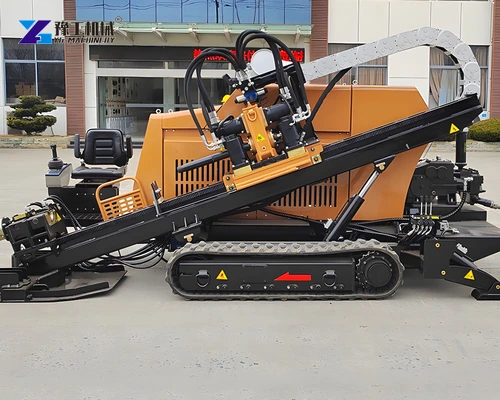
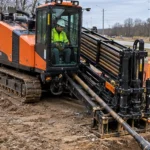
A tracked horizontal directional drill with its main assemblies visible.
What Should Be Included With Directional Drilling Equipment for Sale?
A horizontal directional drill is more than its crawler base. The power unit drives the powerhead; the rack and carriage advance and retract connected rods; and the push-pull system supplies linear force. The bit, steering tool and fluid circuit work at the bore. These assemblies do different jobs, so a photo of a finished rig does not confirm whether rods, locating gear or other equipment are included.
Directional drilling equipment for sale may mean a bare rig, rods, selected tooling or a wider package. Ask for the exact model and itemized inclusions, options and buyer-supplied items. “Complete” is not a defined scope: a base-machine offer may still leave your crew to source equipment required for the first bore.
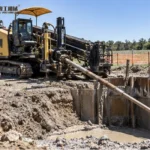
Powerhead and hydraulic assembly on a tracked directional drill.
How Does a Horizontal Directional Drill Install a Pipe?
An HDD crossing starts with a guided pilot bore. The powerhead turns connected rods as the carriage advances; an operator steers the pilot head with a compatible locating system. The pilot hole is enlarged in planned reaming passes, then the product pipe is connected and pulled back. The rig, drill string, tooling, fluid circuit and pipe connection therefore need to work as one installation system.
Drilling fluid circulates through the string and carries cuttings toward the entry pit. Its performance depends on formation, bore profile, tooling and fluid returns. A model’s maximum mud-flow rating is a comparison limit, not proof that a particular fluid mix or crossing will work. For the sequence and its decision points, see the HDD process for utility crossings.
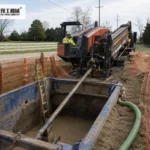
The frame and carriage support the rod advance and retraction sequence.
Which YG HDD Rig Fits Your Crossing?
Use rated power, push-pull drive type, the listed drag/feed force pair and maximum reaming-hole diameter to shortlist the YG models. These are comparison points, not a recommendation based on pipe diameter alone. The YG horizontal directional drill range lists further dimensions; request the full data for your shortlisted configuration.
Model
Rated engine power
Push-pull arrangement
Maximum drag/feed force pair
Maximum reaming-hole diameter
YG-160A
100 kW
Cylinder
160/100 kN
600 mm
YG-180
97 kW
Motor
180/180 kN
600 mm
YG-280
160 kW
Motor
280/280 kN
750 mm
YG-320
140/160 kW
Cylinder
320/320 kN
800 mm
YG-320A
160 kW
Motor
320/320 kN
800 mm
The force pairs are shown in the order listed; ask the supplier to label the push and pull values instead of guessing from the slash. YG-160A and YG-180 both list 600 mm maximum reaming diameter, but differ in power and drive. YG-320 and YG-320A both list 320/320 kN and 800 mm, yet their power and drive arrangement differ. Model numbers alone do not establish a ranking. Ask for confirmation of the exact configuration.
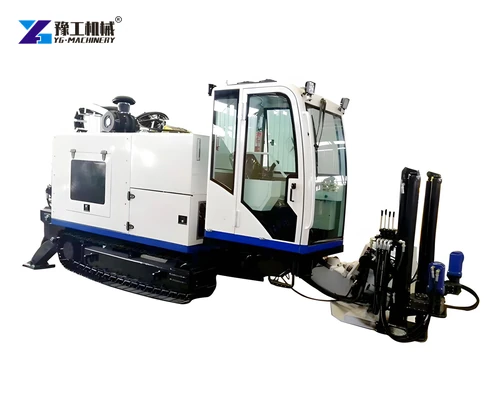
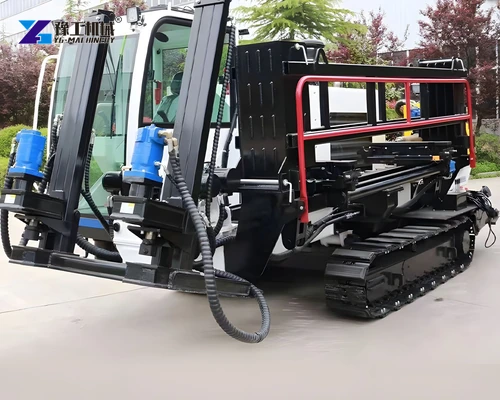
An enclosed cab is one of the visible layouts in the model range.
How Should You Match Rig Capacity to the Bore?
Start with bore length, entry and exit angles, depth, planned curve and available work area. Then consider pipe material, outside diameter, joints and allowable pull load. Ground layers, cobbles, groundwater and nearby services affect steering, tooling and fluid planning. A larger rig may be impractical where access is tight; a narrow pipe alone does not prove that a smaller model will suit the crossing.
Maximum reaming-hole diameter is neither the pipe diameter nor a supplied reamer size, and it does not guarantee a bore in every formation. Bore opening depends on the pipe envelope, installation method, geology and design. Check the listed force pair against the planned drilling and pullback sequence; have the supplier review the geometry and state assumptions.
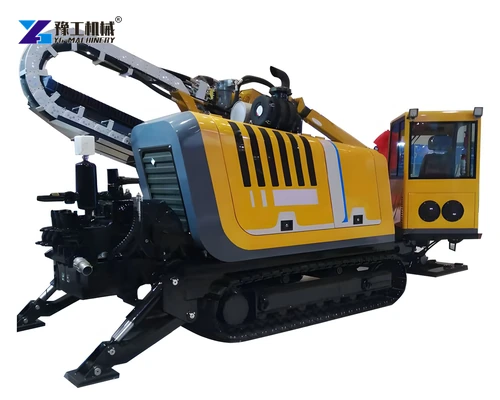
A factory-view HDD rig with its drill frame and crawler base.
Check operating and transport dimensions, weight, loading arrangement and stabilizer footprint against the route and entry-pit space. The model comparison does not show every transport detail; get the shortlisted model’s figures before arranging a trailer, lifting equipment or site access. A rig that fits the bore but cannot reach or set up at the work area is not a practical match.
If you have the bore profile, pipe details and ground notes, shortlist the rig against those conditions before finalizing the package. The model range can then be checked against a real crossing rather than an assumed one.
Which Equipment Should an HDD Rig Package Include?
A useful offer names each component and quantity. Match rod length, diameter and connection to the rig and planned bore. Identify the pilot bit and each reamer by type and size, including the enlargement sequence. During pullback, the swivel and pulling head must suit the pipe and planned load. When comparing directional drilling equipment for sale, these details show whether the offer is a bare rig or a deployable package.
Package item
Why it matters
What to confirm
Drill rods and connections
Build the required string and transmit rotation
Rod size, length, quantity and rig compatibility
Pilot bit and reamers
Create and enlarge the guided bore
Tool type, sizes and planned pass sequence
Fluid equipment and hoses
Deliver fluid to the drilling circuit
Included components, flow interface and site supply
Locating system
Track the pilot head along the bore path
Transmitter, receiver, display and compatibility
Pullback connection
Connect the product pipe to the pullback string
Swivel, pulling head and pipe-specific connection
Transport and commissioning
Prepare delivery and initial setup
Included services, responsibilities and destination
Machine layout and visible connections to review when defining the package.
Build the package around what your crew already owns and can source locally. List compatible fluid or locating equipment to avoid pricing it twice. For items essential to the first crossing, request the make or specification and quantity; this makes “accessories included” a checkable scope.
Select an HDD reamer by type and working diameter for the ground and enlargement plan, not by the rig’s maximum figure alone. Review the HDD reamer options and confirm the tool-to-rig interface in the package list.
A directional drilling rig view showing its rack, carriage and crawler base.
What Should You Check Before Buying New or Used HDD Equipment?
Sales listings can mix new rigs, used machines, individual tools and incomplete packages. Establish exactly what is offered; do not compare a used listing with a new-machine quotation without accounting for condition and scope. For a used rig, ask for identification, operating and service history, wear-area photographs and an itemized list of rods, tooling and controls. Arrange an inspection or test suitable to the purchase before treating it as equivalent to a confirmed machine.
For either type, verify the model, configuration, delivery point, packing, freight, taxes and commissioning responsibilities. Ask for applicable warranty terms and included documents or spare parts in writing. Confirm availability and delivery dates with the seller; listings can become outdated.
What Should You Send to Request Directional Drilling Equipment for Sale?
Help the supplier recommend a model by sharing the crossing location and purpose, bore length and profile, pipe material and outside diameter, known ground, entry-pit dimensions and site access. Add a drawing or site photographs and list equipment your crew already owns. Mark preliminary dimensions as estimates so they are not treated as confirmed.
Bore length, depth, entry and exit geometry, and any curve limits
Product-pipe material, outside diameter, joint type and pullback details
Ground or geotechnical information, groundwater and known buried services
Site access, working footprint, transport restrictions and available lifting equipment
Required model or target capacity, if already specified
Equipment already owned, items required in the package, destination and delivery preference
Ask for the recommended model, full data, package inclusions and unresolved assumptions. To compare directional drilling equipment for sale, give each supplier the same bore brief and scope boundary; this reveals differences in machine fit and package before you order.
Share the crossing plan and the equipment your crew already owns to request a model recommendation and itemized package. This gives the quotation a clear technical and supply scope.
The rig configuration should be checked against the bore and the written offer.
Directional Drilling Equipment for Sale FAQs
What does directional drilling equipment for sale usually include?
It may be a bare rig or add rods, tooling, fluid or locating equipment and commissioning. Ask for every included, optional and buyer-supplied item by name and quantity.
Is maximum reaming diameter the same as pipe size?
No. It is a machine limit, not pipe diameter or a guarantee for a ground condition. Plan around the pipe, geology, tooling and installation method.
How do I choose between YG HDD models?
Compare bore geometry, pipe pullback, ground, access, power, drive type and listed force values. Ask the supplier to confirm the selected configuration against your project.
Are rods and an HDD reamer included?
Not necessarily. Request rod dimensions and quantity, reamer type and size, and other tooling in the written scope. List compatible equipment you already own.
Can I compare a used listing with a new machine quote?
Only after checking condition, history, configuration, inclusions, delivery and warranty. The scope and purchase risk may differ substantially.
What information helps get an HDD equipment quote?
Send the bore profile, pipe details, ground, site-access limits, destination and equipment you own. Mark estimates clearly and ask the seller to state assumptions.
A suitable HDD purchase is the rig and package that fit the crossing, not simply the model with the highest listed number. Compare the working sequence, published limits, tooling and site access together, and resolve package exclusions before approving the order.