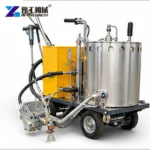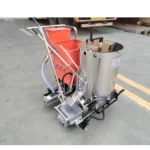

Long road, airport, logistics-yard and industrial routes can expose the limits of a hand-push marking setup. A self propelled road marking machine adds a driven chassis so the operator can control travel and application without continuously pushing the equipment. The purchase decision still begins with the marking material, because thermoplastic, cold paint and two-component systems require different hoppers, pumps, guns or screed assemblies.
The useful question is not whether a driven machine looks faster. Buyers need to match normal marking speed, line width, route length, gradients, turning space, material replenishment and transport limits. YG’s available reference material includes a multifunction thermoplastic configuration with a hydraulic continuously variable drive, pneumatic screed and computer control. The quoted machine should be checked against the actual project instead of treating one reference configuration as universal.
Compare the driven configuration with hand-push and other material-system options in the road line marking machine range before finalizing a fleet plan.
Define the Long Route Before Selecting a Self Propelled Road Marking Machine
Measure the continuous line distance, broken-line pattern, number of intersections and daily closure window. Separate straight production sections from arrows, curves, parking bays and hand-finished areas. A driven machine offers the greatest benefit where the operator can maintain a stable path for long sections. Tight islands or frequent repositioning may still require a smaller companion machine or manual tools.
Record the narrowest gate, turning radius, loading ramp and trailer or container limits. The route may include gradients, crossfall and rough transitions that affect traction and line control. A supplier should review these conditions before confirming the chassis. Maximum travel speed is a machine specification, while acceptable marking speed must be proven with the selected material, width, thickness and road condition.
Send the main project dimensions and material requirement for a model review.
REVIEW MY PROJECT REQUIREMENTS
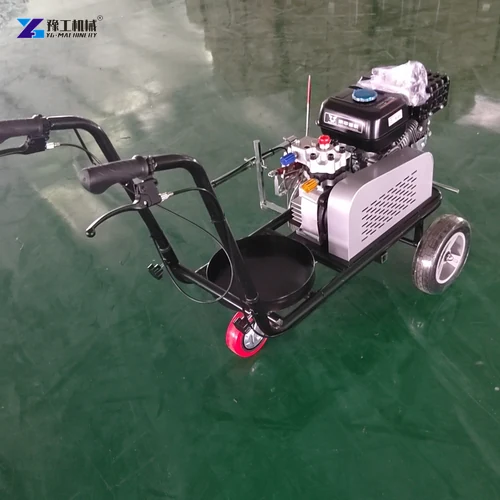

Match the Self Propelled Road Marking Machine to the Material System
For thermoplastic work, the machine needs a compatible heated material path, hopper and screed or extrusion assembly. The prepared YG reference lists a 250 kg coating hopper, 20 L glass-bead tank, liquefied-petroleum-gas heating and a pneumatic screed with a standard 150 mm setup. Width options are listed as 150, 200, 300 and 400 mm, subject to the ordered configuration.
Cold-paint work instead depends on pump flow, pressure, filters, hose, gun and nozzle compatibility. Two-component materials add proportioning and mixing requirements. Do not assume that a driven chassis converts one material system into another. Send the coating technical data sheet and required application method so the quotation identifies the correct material components, cleaning procedure and safety controls.

Compare Drive, Marking Speed and Gradeability
The prepared reference lists a gasoline engine in the 13-18 HP range and an imported hydraulic continuously variable drive. It also lists travel speed from 0 to 20 km/h, marking speed of 1,000 m/h and maximum gradeability below 30 degrees. These values belong to that reference configuration and should be reconfirmed on the final technical sheet before purchase.
Production from a self propelled road marking machine cannot be calculated from travel speed alone. Refill stops, preheating, bead loading, stencil work, traffic control and line acceptance all affect completed distance. Ask for a test using the intended shoe or gun pattern. The operator should be able to start smoothly, hold a straight path, stop material cleanly and repeat the accepted line without sudden drive changes.
| Self-propelled machine parameter | YG product value |
| Engine | 13–18 HP gasoline engine |
| Drive system | Hydraulic continuously variable transmission |
| Air compressor capacity | 0.036 m³/min |
| Thermoplastic material hopper | 250 kg |
| Glass-bead tank | 20 L |
| Heating fuel | Liquefied petroleum gas |
| Marking device | Pneumatic screed; standard 150 mm |
| Control system | Computer automatic control |
| Travel speed | 0–20 km/h |
| Maximum gradeability | Below 30° |
| Listed marking speed | 1,000 m/h |
| Available marking widths | 150 / 200 / 300 / 400 mm |
| Machine dimensions | 2,200 × 1,300 × 1,850 mm |
| Machine weight | 600 kg |


Check Line Width, Bead Delivery and Application Controls
List every recurring line width and identify which must be changed during a shift. For thermoplastic, specify the target thickness, bead application and any raised or profiled marking requirement. A standard 150 mm screed does not automatically cover wider lines; the quotation should name each supplied shoe or assembly and the compatible working range.
Computer control and pneumatic actuation can support repeatable operation, but the control sequence must match the job. Confirm how the operator controls material release, bead delivery, broken-line timing and emergency stop. Verify that gauges and valves remain visible from the operating position. A short factory demonstration should show the ordered controls rather than a different display machine.
Plan Transport, Refilling and Daily Service Access
The prepared multifunction reference lists an equipment size of 2,200 by 1,300 by 1,850 mm and a machine weight of 600 kg. Those figures affect trailer choice, loading method, storage and route access. Ask for final packed dimensions, gross weight, lifting points and securing instructions because packaging and optional assemblies can change the shipment.
Review access to the engine, hydraulic system, air compressor, fuel and heating system, applicator, bead tank and controls. Plan safe material loading and cleaning without blocking the traffic-control zone. The self propelled road marking machine should be supplied with model-specific daily checks, wear parts and operating instructions. Local rules for LPG cylinders, fuel and road transport must be confirmed by the buyer.
Share the intended equipment scope so YG can check the configuration and included accessories.

Request a Complete Self Propelled Road Marking Machine Quote
Send the material system, line schedule, widths, thickness, bead requirement, continuous and total daily distance, gradients, turning space, road condition, crew plan and destination. Add photographs or a route drawing where access is restricted. State whether the project needs one machine or a fleet that separates long production lines from detail work.
Ask the quotation to identify the chassis, engine, drive, hopper or paint system, applicator, width tools, bead equipment, controls, safety devices, spares, factory test, packing and documents. Confirm every model-specific value on the final technical sheet. This scope makes supplier comparisons clearer and helps the contractor avoid buying travel capacity without the material package needed to produce an accepted line.
Provide the final site and delivery details when you are ready for a complete quotation.

Self Propelled Road Marking Machine FAQ for Long Routes
It is most useful on long routes where driven travel reduces continuous pushing and helps the operator maintain a repeatable pace.
No. Thermoplastic, cold paint and two-component systems need different material-delivery and application components.
No. Travel speed is not the accepted application speed; material, width, thickness and line quality control the working pace.
Send material, line widths, thickness, bead needs, route length, gradients, access, transport limits, destination and test requirements.