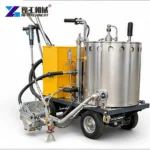
The YG-8S road marking spray machine is a single-gun hydraulic cold-paint unit. Its engine-driven plunger pump delivers compatible liquid coating to a guided spray gun; crews use it for defined pavement-marking work where the paint, nozzle and required width suit the machine.
The distinction from thermoplastic matters: the YG-8S sprays a liquid coating and does not heat or form hot-melt material. Its 100–300 mm listed spray-width range, 4.8 L/min unloading flow and one-gun arrangement help describe what it can do, while the road surface and operator still determine the finished line.
How a Single-Gun Road Marking Spray Machine Works
The YG-8S uses a gasoline engine to power an electronically reversing plunger pump. The hydraulic working system pressurizes compatible cold-paint material and delivers it through a hose to one spray gun. The operator guides the wheeled machine along the planned line while the gun applies the coating to the pavement. The machine handles the pressurized spray cycle; it does not measure the road layout or automatically correct a wandering line.

The single gun is useful where a crew needs to mark a defined path and can manage starts, stops, turns and nozzle alignment. Before spraying, the crew plans the line and prepares the pavement; dust, oil, loose aggregate or moisture can affect adhesion and line appearance. The paint must also be compatible with the pump, hose and nozzle. If coating viscosity or filtration is wrong, flow can become uneven or the nozzle may clog.
This is why the YG-8S should be understood as an application machine rather than a complete marking-quality guarantee. Pressure and flow describe what the machine is rated to deliver. Consistent edges still depend on surface preparation, paint condition, nozzle choice, gun height, operator pace and the acceptance method required for the project.


Road Marking Spray Machine Applications on Roads, Parking Areas and Sites
Cold-paint road markers are used on roadways and highways for lane and edge lines, and in parking lots for bay divisions, arrows and pedestrian crossings where the chosen coating and nozzle can form the specified marking. Factory yards and squares use surface markings to organize vehicle routes, loading zones and pedestrian paths. Airports may also use pavement marking equipment for ground-surface lines where the paint system and project procedure permit.
The work pattern changes between these locations. A long road edge requires a steady, uninterrupted line. A parking layout includes frequent turns, short sections and repeated starts; the operator needs to align the gun and control overlap at each bay. A factory traffic lane may cross old lines, drains or patched pavement, so surface cleaning and layout accuracy become as important as pump flow.
YG identifies the YG-8S as a single-gun cold-paint model. The stated 100–300 mm spray width should be checked against the widths actually required. Broad symbols, multiple simultaneous lines or a specialized profile may need another model or application method; do not assume that the general list of marking applications means this particular one-gun configuration can produce every shape at every width.
- Roads and highways: continuous lane, centre or edge lines using paint approved for the pavement and project.
- Parking lots and squares: parking bays, arrows and crossings, with careful control around short runs and turns.
- Factories and industrial yards: traffic-lane and work-zone markings over cleaned, compatible paved surfaces.
- Airport pavement areas: only where the marking specification, coating and operating procedure suit the selected machine.
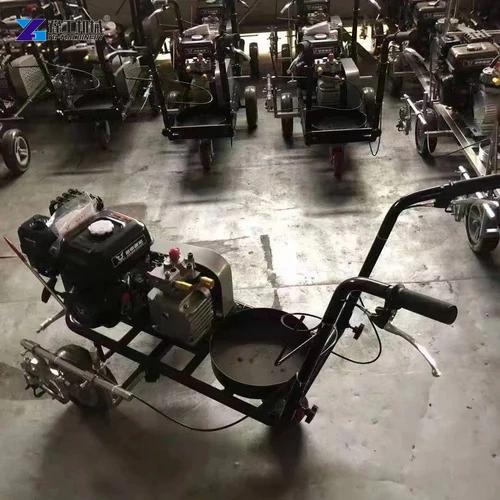

YG-8S Single-Gun Cold-Paint Machine Specifications
The YG-8S figures below belong to the single-gun model. They describe its pump and application envelope; they are not equivalent to a second gun or to the specifications of the YG-8D double-gun model.
| Parameter | YG-8S |
|---|---|
| Engine | 5.5 hp Honda gasoline engine |
| Pump | Electronically reversing plunger pump |
| Spray guns | 1 |
| Working mode | Hydraulic |
| Pressure | 8–12 MPa |
| Unloading flow | 4.8 L/min |
| Spray width | 100–300 mm |
| Spray thickness | 0.2–0.4 mm |
| Dimensions | 1,600 × 800 × 1,200 mm |
| Weight | 120 kg |
The cold-paint road marking machine configurations is distinct from the double-gun YG-8D and from a thermoplastic road marking machine. The model name matters because pump flow, gun count and width range change between configurations.
A short test on the actual pavement can reveal whether the selected coating, nozzle and walking pace produce the required line edge.
CHECK A COLD-PAINT CONFIGURATIONWhat Controls Line Width, Thickness and Edge Quality
The listed spray-width range is a starting boundary, not the only factor that sets the stripe. The nozzle opening, pressure, paint viscosity, gun-to-surface distance and speed of travel work together. If the machine moves faster while pump delivery and nozzle setup stay unchanged, the wet film may become thinner; if the operator slows down without adjusting application, the coating can build up or spread beyond the intended edge.
A practical setup begins with the project line width and coating specification. Clean a test area, check the selected paint’s mixing and filtration instructions, confirm the gun is aligned with the guide and make a short trial pass at a controlled walking pace. Inspect the line edge, coverage and thickness using the project’s method. If the line is too narrow or irregular, check nozzle wear, gun position and travel path before changing several variables at once.
Pavement condition affects the result too. Rough aggregate creates a different contact surface from smooth concrete; cracks, patches and dust interrupt the spray pattern or bonding. Marking crews should decide whether cleaning, drying, priming or repairing is required by the coating specification. Machine flow cannot compensate for a surface that is unsuitable for the chosen paint.

Cold-Paint Spraying and Thermoplastic Marking Are Different Processes
The YG-8S sprays liquid cold-paint material through a pump and gun. A thermoplastic line marking machine applies heated marking compound through a shoe or mould after the material has been melted and kept at its working temperature. These are different materials and workflows, not two modes that can be selected on the same machine.
Choose cold paint when the project specification calls for a compatible sprayed coating and the one-gun width range suits the layout. Choose thermoplastic equipment when the specified material must be heated and formed as a hot-melt line. That process adds heating, temperature control, hot-material transfer and mould selection; a cold-paint pump should not be quoted as its substitute.
The distinction also changes the work sequence. Cold paint is prepared, filtered and pumped to the spray gun. Thermoplastic powder or granules are heated and stirred in a kettle or the designated heating vessel before being transferred to the applicator. Selecting the method first prevents the crew from receiving a machine that is mechanically sound but built for the wrong coating.

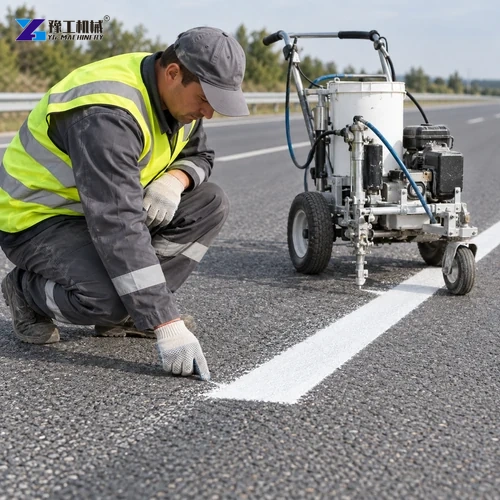
When the YG-8S Is a Practical Marking Machine
The YG-8S is a practical option when the job uses compatible cold paint, the required width falls within its 100–300 mm range and a crew can guide one spray gun over prepared pavement. Road edges, parking-bay lines and factory traffic routes are examples of tasks where a controlled single-gun pass can suit the work.
Its limits are equally important: it does not place thermoplastic, automatically map a parking lot or guarantee retroreflectivity, thickness or line acceptance. Those outcomes depend on the specified material, surface, nozzle and operator procedure. A test strip using the actual coating and pavement is the simplest way to see whether the setup is producing the required edge and film before the full marking run.
Road Marking Spray Machine FAQs
The YG-8S is a single-gun hydraulic cold-paint machine. It pumps compatible liquid marking paint through a spray gun onto prepared pavement; it is not a thermoplastic hot-melt applicator.
YG lists roadways, highways, parking lots, factories, squares and airports, for suitable lines and pavement markings. The one-gun setup and 100–300 mm listed spray-width range should be matched to the project layout.
The published YG-8S range is 100–300 mm. Actual line geometry also depends on the nozzle, paint, gun position, walking pace and the surface.
YG lists an unloading flow of 4.8 L/min and pressure of 8–12 MPa. These are machine parameters, not a guarantee of line output per hour; paint and application conditions affect the result.
No. Cold paint is pumped as a liquid coating. Thermoplastic is heated, kept workable and applied through a shoe or mould; it needs a different material-handling process and equipment configuration.
Request a Project-Specific Quotation
Tell us the product configuration and the work it needs to perform so the team can review the scope against your project.