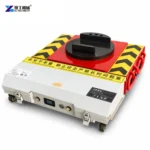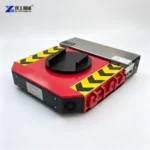
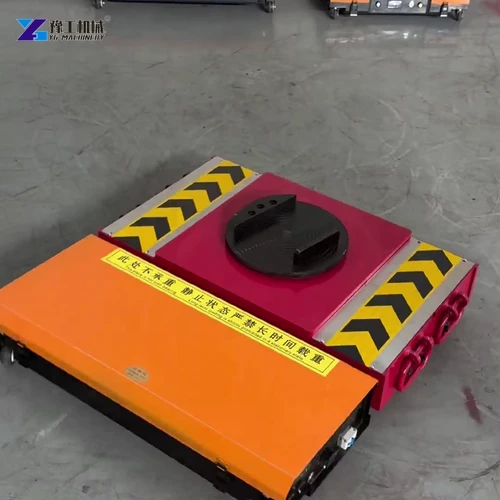
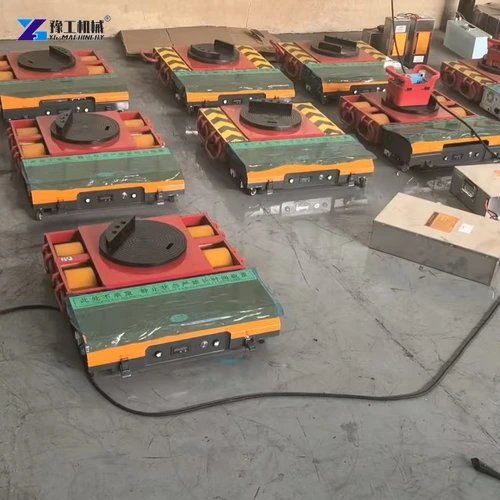
An electric machinery skate and an air-caster system can both help reposition heavy equipment, but they carry and move the load through different interfaces. The skate uses wheels or rollers in contact with the floor. An air caster uses supplied compressed air to create a supporting film beneath its modules. That difference changes the demands on the floor, site services and positioning method.
Neither system can be selected responsibly from load weight alone. A machine that must cross workshop joints before entering an installation bay presents a different task from a load that needs small sideways adjustments within a suitable continuous-floor area. Compare the complete movement, including loading and final support, rather than a single attractive demonstration.
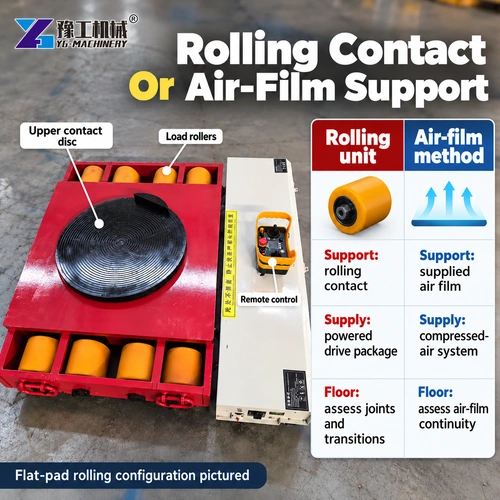
Electric Machinery Skate Drive Works Through Rolling Contact
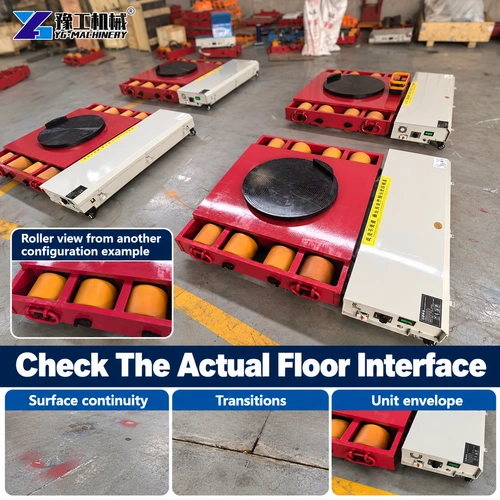
A battery-powered moving skate transmits motor torque through its drive arrangement to the running surface. The supported reaction passes from the machine’s approved contact area through the chassis and wheels to the floor. The floor therefore receives concentrated contact loads while also providing the contact needed for movement.
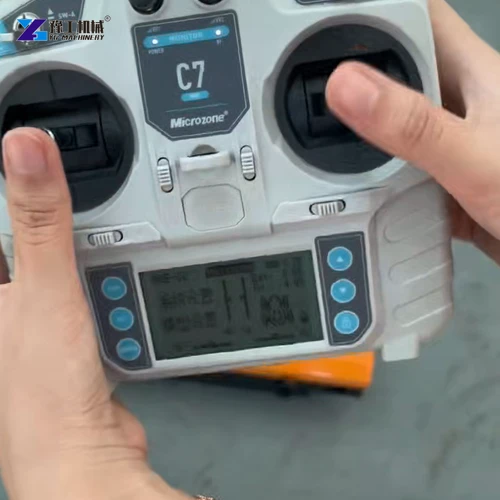
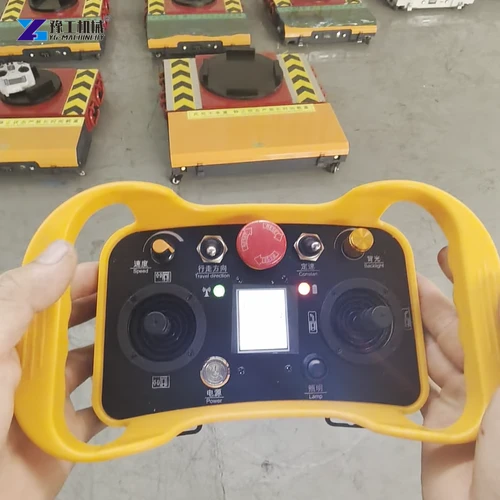
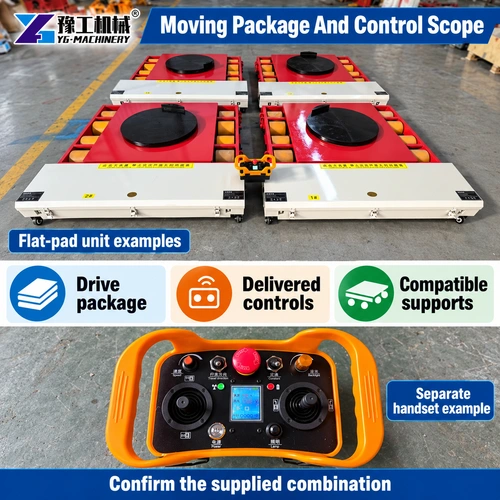
The handset commands the powered chassis; it does not remove those mechanical requirements. Wheel contact, the supported reaction, follower behaviour and resistance along the travel path still determine how the complete arrangement responds. A remote operator can stand away from the drive unit, but needs a suitable view and a means of knowing what is happening at other supports.
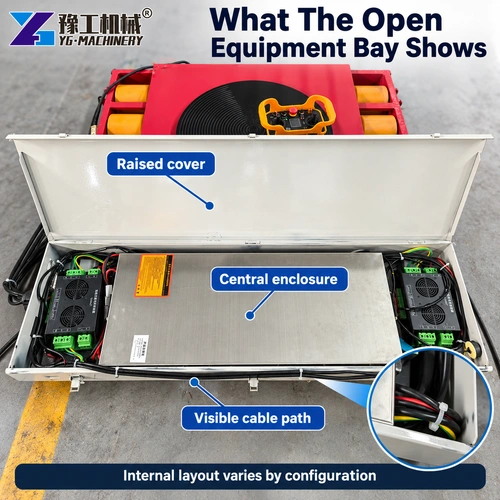
An electric machinery skate may suit a plant seeking battery-powered floor travel without a continuously connected compressed-air supply. This does not make it independent of site infrastructure. It still needs an appropriate charging arrangement, suitable supporting surfaces and equipment for placing the machine onto its moving supports.
The powered chassis also does not establish the steering behaviour of every follower in the package. Confirm how the supplied arrangement changes heading and whether a proposed sideways adjustment requires repositioning supports. Do not assume that remote control makes a wheeled system move freely in every direction under a load.
Compare the wheel-supported or air-film-supported method against the positioning task.
Air-Caster Support Depends On The Floor And Air Supply Together
An air-caster module receives compressed air through its distribution system. In a compatible arrangement, air passing beneath the module establishes the supporting film between the module and floor. The resulting interface can allow movement in different horizontal directions, but only within the requirements of the selected system and supported load.
The supporting film reduces resistance; it does not by itself provide commanded horizontal propulsion. A basic air-caster arrangement needs a suitable way to apply and control the moving force. Some complete systems add drive equipment, but that is a separate system feature, not a property of every air module. Compare that arrangement with the motor-driven wheel contact of the YG option.
The floor is part of that operating interface, not merely a route. Surface texture, flatness, porosity and discontinuities can affect the ability to establish and maintain the air film. A system designed for a suitable sealed floor should not be presumed to perform the same way on rough concrete, open joints or a damaged coating.
Compressed-air availability must be assessed at the working modules under the required duty. A nearby compressor does not establish adequate delivered pressure and airflow through the actual hose arrangement. Distribution losses, simultaneous module demand and other air users can matter. Use the air-caster supplier’s requirements rather than applying an unrelated workshop-air figure.
Hoses also occupy space and must be managed through the intended motion. An air-film demonstration without its supply equipment does not show the complete installation. Comparing an electric machinery skate with air casters therefore means comparing battery and charger requirements against the complete air supply, distribution and floor interface, not just comparing two support modules.
Describe the floor finish and transitions to assess the rolling option for your plant.
Electric Machinery Skate Specifications
These YG configurations illustrate the powered wheeled option. Their figures do not specify the capacity or air demand of an air-caster system. Each alternative needs its own matched support arrangement and operating conditions.
| YG electric machine skate configuration | 10T | 25T | 40T |
| Powered-unit load capacity | 10 metric tons | 12.5 metric tons | 20 metric tons |
| Listed towing weight | 10 metric tons | 25 metric tons | 40 metric tons |
| Motor arrangement | 500 W × 2 | 1000 W × 2 | 1500 W × 2 |
| Overall dimensions | 500 × 550 × 145 mm | 670 × 635 × 165 mm | 810 × 800 × 182 mm |
| Battery voltage and capacity | 48 V, 30 Ah | 48 V, 60 Ah | 48 V, 120 Ah |
The 25T configuration lists a 12.5-ton powered-unit load capacity and a separate 25-ton towing weight. The towing number must not be used as the load permitted directly on its support. Check the reactions at the powered unit and followers rather than treating the total machine weight as one evenly distributed number.
Chassis height also affects loading and landing. A low interface can be useful only if the approved insertion method, available clearance and companion supports are compatible. Neither a larger battery nor a more powerful motor corrects an unsuitable support point beneath the machine.
Compare the YG carried-load rating and chassis height with the intended support arrangement.
Floor Transitions And Directional Adjustments Decide Practical Fit
Wheels and an air film encounter a joint in different ways. A wheel must roll over or across the discontinuity while maintaining suitable support and contact. An air module may lose air across a gap or encounter a surface on which its film cannot be maintained. Neither method makes floor openings irrelevant.
A strong floor and a compatible running surface are two different requirements. For example, a cover may appear flush but lack the capacity for concentrated wheel loads. Conversely, a structurally adequate concrete slab may have an open joint that disrupts an air film. Identify which limitation applies at each transition instead of treating the floor as a single pass-or-fail surface.
The final adjustment deserves equal attention. Moving down a long aisle and making a small lateral correction beside a foundation are distinct motions. Air-film support may be relevant where multidirectional adjustment on a suitable floor is important. A wheeled arrangement needs an approved method for achieving the required change of direction without forcing followers or side-loading contacts.
Compare an electric machinery skate against the actual sequence: approach, turns, transition into the installation area and final alignment. Do not infer positioning precision, gap-crossing ability or floor-protection guarantees from an unloaded video. The machine geometry and complete support arrangement determine whether the demonstrated motion transfers to the proposed job.
Identify which directional adjustments the full machine must make during placement.
Electric Skate And Air-Caster Loading And Landing
The useful comparison includes what happens before and after horizontal travel. An air caster can raise the load through its designed inflation movement, but this does not establish the insertion clearance or lifting range needed for a particular machine. A wheeled skate likewise needs a defined loading method. Either arrangement may therefore need separate lifting equipment, and both must eventually transfer the machine onto its permanent supports.
- Load support: wheeled skates transmit weight through rolling contacts; air casters support it through an air film while operating. Each needs suitable structural contacts beneath the machine.
- Movement and direction: the electric skate supplies drive through its wheels. An air film reduces movement resistance, but the complete system still needs a controlled horizontal force. Steering and sideways positioning depend on the supplied arrangement.
- Site services: the YG drive uses a battery and matching charger; air casters need a compatible delivered compressed-air supply and hose arrangement. Compare the complete services, not just the moving modules.
For equipment regularly moved between suitable positions, compare the repeat setup work as well as the travel mechanism. Charging, air-system connection, hose management, support placement and receiving-station readiness consume different resources. There is no defensible universal claim that one method always needs fewer people or produces a lower total cost.
- Define the machine’s transport condition, approved contact locations and reactions at the moving supports.
- Check the complete route and positioning motions against the wheel or air-film interface, including floor transitions and available site services.
- Compare the supplied support, loading and landing package, along with training, inspection and maintenance requirements.
For a wheeled moving-system comparison, describe the required support reactions, floor interface and direction changes rather than asking for a tonnage-equivalent replacement alone. Choose an electric machinery skate for its rolling and driven functions, while evaluating air-caster support and any separate propulsion equipment on their own merits.
Electric Machinery Skate FAQs
The YG configurations compared here use battery-powered drive. A separate pneumatic accessory, if included in a particular handling package, would need its own supply specification; do not confuse it with the skate’s drive source.
No such assumption is justified. Surface condition, porosity, flatness and discontinuities must suit the selected air-caster system, as must the delivered compressed-air supply.
The air film provides support with low resistance to movement. Horizontal movement still needs a controlled applied force; powered propulsion is an additional feature of a complete system, not an automatic function of every air caster.
The permitted motion depends on the powered unit, followers and loaded arrangement. Confirm the method for changing direction; remote control alone does not establish unrestricted lateral travel.
That cannot be guaranteed from the mechanism alone. Evaluate the floor, load, contact conditions and operating method with the equipment suppliers and responsible site personnel before choosing a system.
Describe the machine support reactions, floor transitions and required positioning motions to discuss whether the YG wheeled arrangement suits your plant.