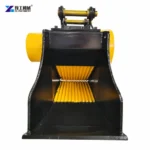
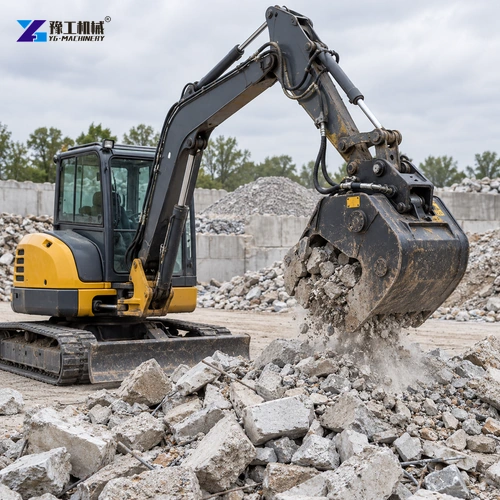
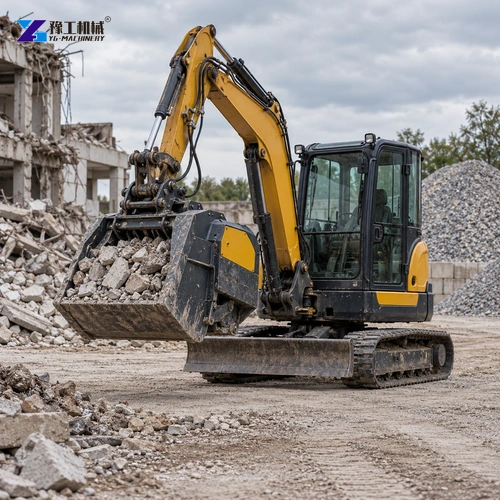
If a demolition crew is moving concrete away only to bring usable aggregate back later, an excavator crusher bucket may shorten that material loop. The bucket uses the excavator’s hydraulic power to crush suitable stone and construction waste at the work area; that can reduce repeated handling when the material is clean enough and a reuse point is close. The important question is not simply whether the machine can crush concrete. The feed must fit the opening, the desired fragment size must be achievable, and the excavator must supply the required hydraulic flow and pressure while remaining stable.
This guide helps you decide when a hydraulic crusher bucket suits a project, how to prepare the feed, and how to read the YG-4 example without treating its maximum production figure as a guaranteed shift output. For the available attachment family, see the excavator rock crusher bucket; for the factors that affect real throughput, compare the concrete crusher bucket output guide.
Why a hydraulic crusher bucket can change concrete waste handling
The bucket’s practical advantage is that crushing can happen near the demolition face. Instead of loading every large block into a truck, hauling it to a separate crushing point and transporting the processed material again, the excavator can reduce suitable pieces during the same site operation. Fewer transfers can make a difference on a constrained project where truck access, temporary stockpiles or a separate crusher setup are difficult.
That benefit depends on the site’s material loop. Before choosing the attachment, identify where the crushed material will go: a designated temporary stockpile, a later reuse area, or a collection point for onward transport. If there is no safe place to feed, crush and store the material, or if concrete is mixed with waste that must remain separate, crushing in the bucket may add sorting work instead of removing it. A bucket also does not replace a production plant when the job needs continuous high-volume processing, controlled screening or several aggregate fractions.
Send the feed photos and intended reuse point so the bucket can be judged against your material loop.
CHECK MY MATERIAL AND REUSE PLAN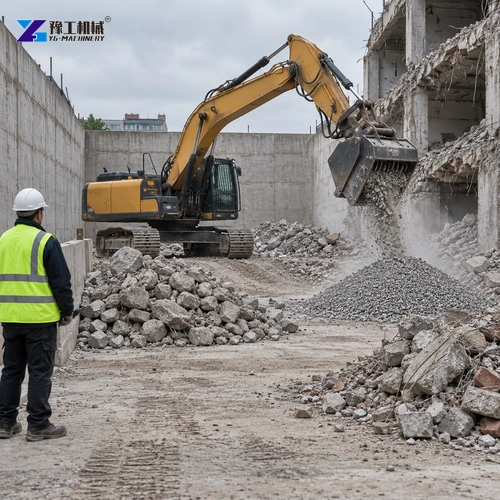
Prepare concrete and demolition feed before it enters the crusher bucket
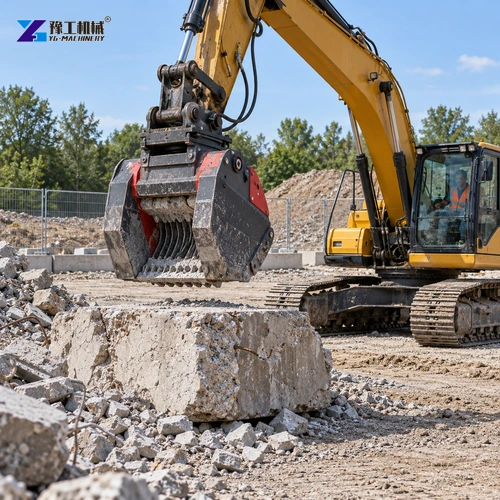
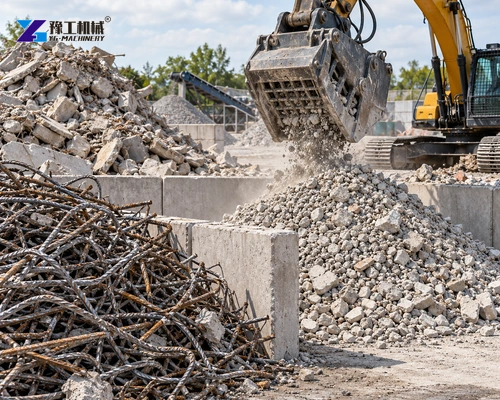
Feed preparation determines whether the attachment can work smoothly. First separate concrete from timber, soil, plastic and other material that should not enter the crushing chamber. Expose and remove long steel pieces where the job method requires it; reinforcing bar entangled with concrete can interrupt the feed and complicate the reuse pile. Then break oversized members into pieces the bucket can accept rather than forcing a piece against the opening.
Next, decide whether the material is consistent enough for one output target. A pile containing slabs, thick footings and mixed rubble will not feed at the same rhythm. Keep unlike material in separate batches, note the largest incoming piece and identify whether the crushed aggregate will be used as general fill or needs a more controlled size. The setting range is not a promise that every incoming shape will produce identical fragments: moisture, reinforcement, hardness and feeding rhythm affect what leaves the bucket. If the reuse specification is strict, ask whether a separate screen or secondary processing step is needed.
For a useful field trial, select a representative clean batch, record the incoming size and reinforcement condition, then observe the feed cycle and discharged material. If bridging, steel entanglement or irregular oversize fragments occur, pause and change the feed preparation or material route; do not solve a material mismatch by repeatedly forcing the excavator against the bucket.
YG-4 hydraulic crusher bucket parameters and what they mean on site
The YG-4 is a concrete comparison point for an excavator in the listed carrier class. The opening dimensions help screen incoming pieces, while the output setting range describes the adjustment window. Oil flow and pressure must be compared with the excavator’s auxiliary circuit at the attachment connection—not inferred from the machine’s nameplate alone.
| Parameter | YG-4 |
| Product model | YG-4 |
| Carrier weight | 25–30 t |
| Load capacity | 0.70 m³ |
| Opening dimensions | L850 × H510 mm |
| Output setting | 15–135 mm |
| Length × width × height | 2050 × 1300 × 1400 mm |
| Weight | 3 t |
| Oil flow | 160 L/min |
| Pressure | 220 bar |
| Counter pressure | 10 bar |
| Max. production | 34 m³/h |
Treat the maximum-production entry as a published machine rating, not an hourly promise for every demolition pile. Real output also depends on how quickly the excavator can feed consistent pieces, how much reinforcing steel must be removed and whether the material can be moved away without blocking the next cycle. The YG-4 row does not mean the same configuration suits every carrier at the edge of its weight range; confirm the excavator’s lift and hydraulic capability at the actual reach.
Share the largest feed piece and target output to compare them with this published YG-4 configuration.
COMPARE THE YG-4 WITH MY FEED SIZE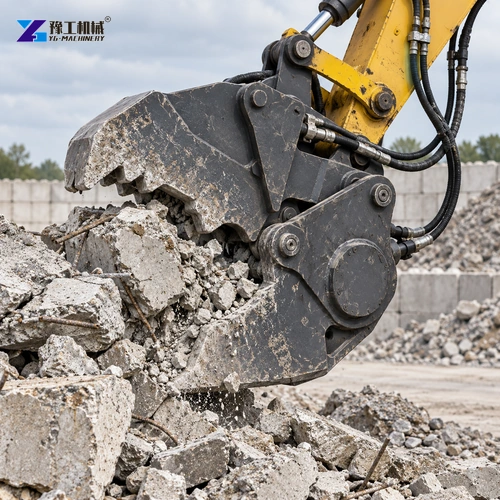
Match the crusher bucket to the excavator and the full work cycle
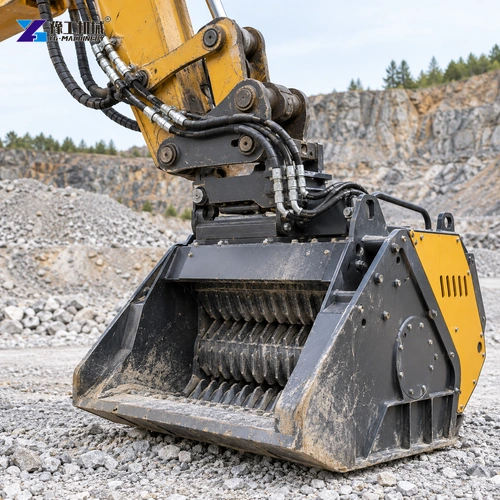
Check the excavator’s auxiliary flow and pressure at the operating condition in which the bucket will work. Then verify the return circuit, hose and coupler arrangement, mounting dimensions and control method with the attachment supplier. A nominal flow value alone is not enough: a restricted return or incompatible connection can prevent the bucket from working as intended. The excavator must also carry the attachment safely at the working radius and over the site’s ground conditions.
Plan the surrounding cycle as carefully as the hydraulic match. The excavator needs room to approach the pile, position the bucket, feed material and turn toward the stockpile without crossing people or active haul routes. Define who will remove steel, where oversize pieces will be staged, and how the processed material will be checked before reuse. If the attachment must travel between separated work faces, compare that travel time with the time saved by crushing on site. This simple sequence review often reveals whether the bucket will stay productive or spend much of the shift waiting for feed and haulage.
Before a purchase decision, prepare the excavator model and hydraulic measurements, pile photographs, representative feed dimensions, target output size and intended material destination. Those details allow a practical compatibility and package review rather than a match based on excavator tonnage alone.
Provide the carrier’s measured auxiliary flow, pressure and mounting details for a practical compatibility review.
REVIEW MY EXCAVATOR AND BUCKET MATCHRun a short acceptance trial before committing the whole demolition stream
Use a representative trial batch to check three separate parts of the work cycle:
- Can the excavator feed the bucket without unstable positioning or repeatedly forcing oversized pieces?
- Does the discharged material suit the project’s intended reuse or next processing step?
- Can the crew remove and stockpile the output without blocking the next feed cycle?
Record the material type, feed preparation, attachment setting, operating interruptions and discharged-pile condition. Those observations are more useful for planning than multiplying a catalogue maximum by the shift length.
If the trial reveals long waits for steel removal, repeated hand clearing or no available stockpile, revise the work plan before expanding the crushing operation. If the aggregate is intended for a defined construction use, have the project engineer or responsible material lead determine the applicable acceptance checks; the crusher setting alone does not certify a material for a particular use. When the project needs several tightly controlled sizes, compare an on-site bucket with a screening or stationary-crusher package rather than assuming one attachment can perform every downstream task.
Send a representative material photo and job location to plan a short, measurable trial.
PLAN A MATERIAL TRIAL WITH YG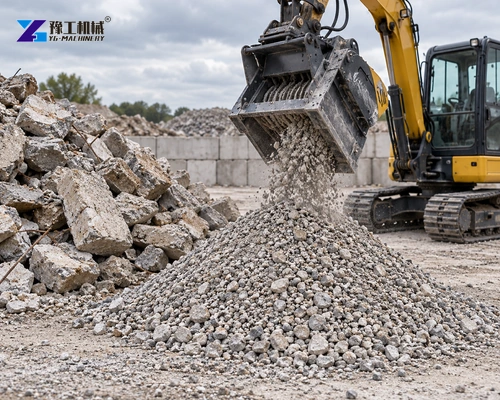
Hydraulic crusher bucket FAQs
It can process suitable concrete, but reinforcement affects feeding and discharge. Separate or cut long steel where the work method requires it, and trial a representative batch before planning the full shift.
No. The listed maximum is a machine rating. Actual output changes with feed size, concrete condition, reinforcement, excavator cycle time and material handling around the bucket.
Compare measured auxiliary flow and pressure, return-circuit limits, couplers and mounting dimensions, then check the carrier’s lift capacity at the working radius with the attachment installed.
The listed YG-4 output-setting range is 15–135 mm. The resulting material still depends on feed consistency and operating conditions, so check a trial batch against the intended reuse.
Not always. It suits selected on-site material loops where mobility and reduced handling matter; a stationary system may be preferable for continuous high-volume processing, screening or multiple tightly controlled fractions.
Send the excavator’s hydraulic data and mounting details, photos and approximate dimensions of the feed, reinforcement condition, target material size, site access and the planned destination for the crushed aggregate.
Prepare the project details for a useful crusher bucket quotation
The most useful first comparison is the actual material route: what will enter the bucket, where the excavator can work and what will happen to the output. Share the carrier data, representative material photographs and intended reuse so a suitable attachment and work sequence can be discussed. The form below is for those job-specific details.