
Buying a GRC machine requires a clear answer to one question: where will the reinforcing glass fibres enter the material? In traditional spray-up, the cement-based slurry travels to the gun separately from the glass-fibre roving, which is chopped at the gun. In premix production, chopped fibres enter the material during mixing, before casting or any subsequent pumping.
Both routes produce glassfibre reinforced concrete, also called GFRC, but they place different demands on mixing, conveying and application equipment. A buyer expanding a moulded-component workshop should compare the complete production route rather than assume that a pump and a fibre gun can accept any reinforced mixture.
GRC Spray-Up Adds Fibre At The Gun
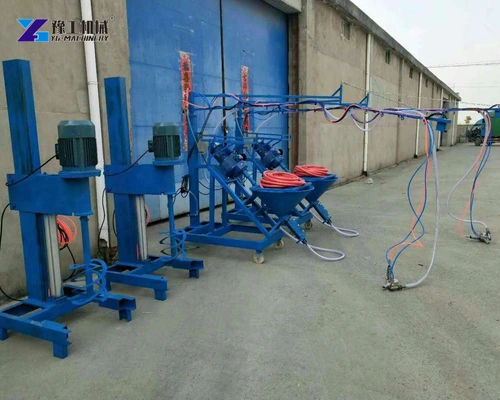
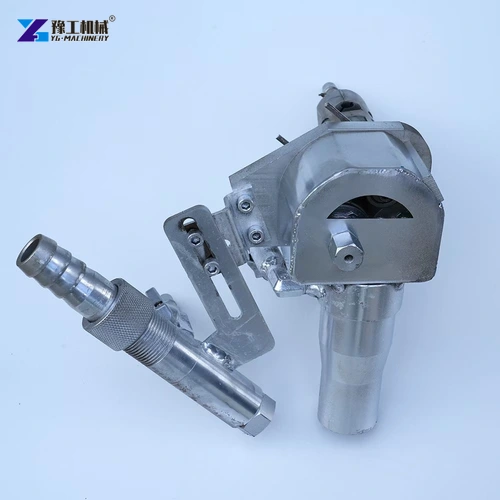
In a traditional spray-up arrangement, the mixer prepares the cementitious matrix: the cement-based slurry before the reinforcing fibres are added. A pump delivers that matrix through a hose, while a separate feed brings continuous glass-fibre bundles, called roving, to a chopper at the spray head. The chopped fibres meet the sprayed matrix during application to the mould.
Keeping the two feeds separate has an important consequence: the matrix pump does not have to convey the same fibre-filled material used in a premix process. The chopper, roving feed and spray head are functional parts of the production package, not interchangeable accessories added to an ordinary plastering gun.
The operator must coordinate the matrix output, fibre delivery and movement across the mould. A change in one feed affects the deposited composite. A broad face offers a different spray path from a narrow return—a turned-back edge or recessed sidewall—where access and material build-up become more demanding.
Spraying is followed by the consolidation and thickness-control operations specified for the component. Consolidation means compacting the freshly deposited material, commonly with suitable rollers in traditional hand spray-up, to help remove trapped air and bring the matrix and fibres into close contact. Thickness checking addresses how much material has been built up across the mould. These operations help form a consistent section; pump delivery alone cannot describe the finished part because mould geometry, deposition and subsequent treatment also affect the result.
Match the matrix feed, fibre chopper and gun to the proposed spray-up arrangement.
Premix GRC Changes The Mixing And Conveying Task
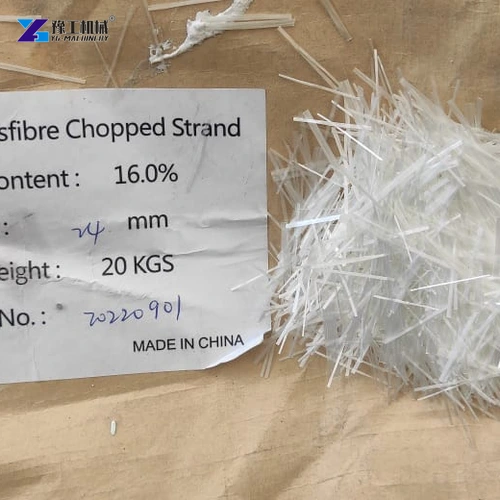
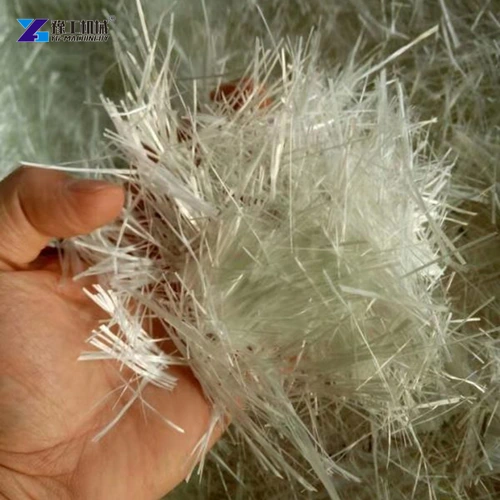
Premix puts chopped alkali-resistant glass fibres into the cementitious mixture before placement. The mixer has to distribute them without excessive damage to the strands. This makes fibre incorporation a distinct stage rather than a reason to keep mixing at the highest available speed.
The resulting material can be cast into a mould using an appropriate production process. Sprayed premix is another route, but it requires conveying and spraying equipment designed for the fibre-containing mix. A successful slurry-pumping demonstration is not evidence that the same pump will handle that premix.
Fibres change the mixture’s flow behaviour. Strand condition, fibre content, grading and mix consistency interact with the conveying route. Adding water simply to force a difficult mixture through a pump changes the material rather than resolving the underlying equipment or formulation mismatch.
For a buyer comparing GRC machines, identify which material enters each unit: fibre-free matrix at the spray-up pump, or fibre-containing premix at a premix conveying system. This distinction explains why visually similar pumps or mixers can belong to different production arrangements.
Specify whether the conveying system will handle matrix or fibre-containing premix.
YG GRC Spray Machine Parameters
| Parameter | YG Glass Fiber Reinforced Concrete GRC Spray Machine |
| Listed power range | 2.2–4.0 kW |
| Electrical supply | 380 V, 50 Hz |
| Listed rotational speed | 20–200 r/min |
| Delivery capacity | 300–1,600 kg/h |
| Listed volume | 60 L |
| Sprayer dimensions | 2,000 × 1,050 × 1,600 mm |
| Mixer dimensions | 1,550 × 1,000 × 2,100 mm |
| Total weight | 800 kg |
This table describes the named GRC spray-machine package. Delivery capacity describes the mass of material conveyed per hour, while finished component output also depends on thickness, mould geometry and the remaining production operations. Capacity in litres, rotational speed and material throughput describe different properties; they must not be substituted for one another when comparing equipment.
For spray-up purchasing, connect these machine parameters with the proposed mixer, matrix pump, fibre chopper and gun arrangement. For a proposed premix route, obtain the corresponding material-handling specification rather than transferring this spray-unit table to a different process.
The separate sprayer and mixer dimensions describe two equipment positions to include in the workshop plan. The complete arrangement also needs access for material handling, hose movement and cleaning. The listed electrical supply and power belong in the utility assessment, while the total package weight belongs in delivery and handling planning. These figures help plan the selected package; they do not establish compatibility with another production route.

GRC Equipment Selection For Three Moulding Tasks
- Broad panel faces made by traditional spray-up. An accessible mould face allows the operator to build material in successive passes. A coordinated spray station needs to feed the matrix and reinforcement throughout those passes, with space for thickness checking and the specified roller consolidation. A high pump output is useful only while the operator and the following work can use that material.
- Repeated components made by cast premix. Here, the equipment has to prepare and place a consistent reinforced batch into each mould. Compare the mixing stages, batch handling and the specified consolidation method. Corners and narrow mould features make filling behaviour important even when the overall component is small; they cannot be judged from mixer volume alone.
- Components placed using sprayed premix. Where the selected process calls for spraying a mixture that already contains fibres, the conveying system has to carry that reinforced material to the gun. Evaluate the pump, hose and head together using the actual mix. A traditional matrix-delivery demonstration answers a different equipment question.
These are equipment choices as well as production choices. A workshop making one repeated moulded item may organise its work differently from one producing large faces with deep returns. The component design, specified material and process qualification determine the appropriate route; no route is automatically best merely because its equipment list is shorter.
A mixed workshop should identify which operations genuinely share equipment and which require separate functions. A mixer suitable for matrix preparation still needs a suitable fibre-incorporation stage for premix. A spray-up chopper does not perform the mixing job, and a casting station does not supply a spray gun.
Mould access can change the selection within the same production route. A deep return interrupts the gun’s approach and makes complete deposition and consolidation harder to observe than on an open face. Machine position, hose support and access for local work therefore need to suit that geometry. A useful equipment trial produces a complete representative section, including its difficult edges and recesses, rather than demonstrating only the easiest flat area.
Compare complete packages for the chosen component production route.


A Useful GRC Equipment Trial Follows The Material
Evaluate the intended material and representative mould together. Follow the material from batching and mixing through conveying or casting, then application and consolidation. This reveals whether the machine arrangement fits the process rather than only showing that a motor runs or a gun emits material.
For spray-up, assess matrix and fibre delivery together over the intended working range. For premix, assess strand distribution and condition after mixing, then the behaviour of the material during the proposed placement route. Use the component’s specified thickness and quality checks rather than treating surface appearance as the sole result.
Plan the surrounding work as well: handling prepared moulds, access to the gun and hose, cleaning the supplied equipment and maintaining the specified curing conditions. These tasks determine whether a production arrangement can be repeated consistently; they are not described by pump output alone.
The purchasing conclusion is straightforward. Select the GRC production route, identify where the fibres enter and then specify the machines that handle the material at each stage. That creates a coherent equipment package instead of a collection of components assumed to be universally interchangeable.
Include the intended material, representative mould and quality checks in the equipment trial.
GRC Machine Selection FAQs
Spray-up chops and adds fibre at the gun while conveying the matrix separately. Premix incorporates chopped fibre during mixing, so any subsequent conveying equipment handles the reinforced mixture.
The fibres travel through the pump with the mixture instead of entering at the spray gun. Strand condition, fibre content and mixture flow behaviour therefore become part of the conveying duty. Select the pump and delivery route for that actual reinforced material.
Premix describes when the fibres enter the material. It can then be cast or, with suitable conveying and spraying equipment, sprayed. The placement route determines the additional machinery required after mixing.
No. It is material delivery. Component thickness, mould shape, application, consolidation and handling determine accepted production output.
Spraying places material on the mould, while the specified consolidation work compacts that fresh layer. A deep sidewall can be reachable by the gun but awkward to reach with a suitable roller. Compare access for both operations and the component’s thickness checks, rather than assessing the spray path alone.
Describe the components, material route and mould types for a GRC equipment review. See the GRC spray machine overview for related equipment. The proposed package must identify the functions supplied for the selected process.